This story appeared in the Metro North section of The Indianapolis News and The Indianapolis Star the day before Valentine's Day, 1998.
Killed in France in 1944, Raymond Kelley
Still Takes Care Of His Bride
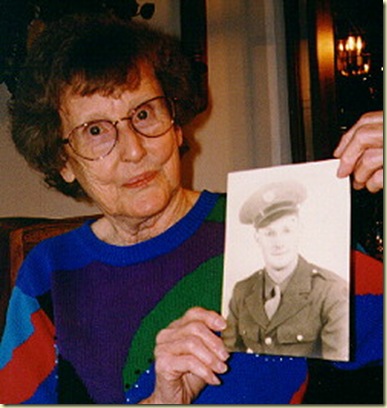
Daphne Cavin with a photo of first husband Raymond Kelley, killed in France in World War II.
By John M. Flora
STAFF WRITER
LEBANON, Ind. – “This is a love story,” said Daphne Cavin with a smile as she swung open the big photo album on her daughter's dining room table.
With aging black-and-white snapshots and other mementos Scotch taped to its black pages, the album is the 78-year-old Lebanon woman's fondest keepsake of her first love and a Boone County boy who died in France more than half a century ago.
Daphne was 21 and Raymond Kelley was 19 when mutual friend Mamie Gates introduced them at a Sunday school party in August of 1941.
Daphne was a beautician in Lebanon at the time and Raymond was working for Kingan Meat Co. in Indianapolis. They began dating and seeing more of each other.
Raymond was visiting at her parents' home just south of Lebanon on Old U.S. 52 on Sunday, Dec. 7, 1941, when news came over the radio about the Japanese attack on Pearl Harbor. “I was sitting on his lap and he pushed me off and ran into the kitchen to tell my mother,” she recalled.
Despite an uncertain wartime future, Daphne and Raymond were married the next June at her parents' house.
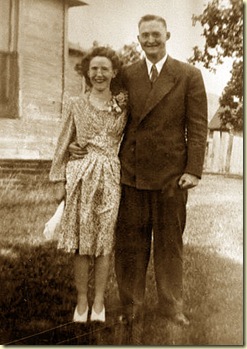
Daphne and Raymond's wedding photo.
“It was a windy day,” she said, pointing to a photo of the slightly windblown, but happy couple in the front yard of the farmhouse.
On the next page were photos of Daphne and Raymond and some of her nieces and nephews from Kansas, gathered at the family home for a reunion a few months into their marriage.
Raymond's draft notice arrived Oct. 26 and a short time later he left for training at Camp Shelby near Hattiesburg, Miss.
“I went down and visited him over Christmas and went back at Eastertime,” she said, pointing to snapshots from those happy times. “We stayed at the Methodist parsonage and I remember we stood up with another couple who got married – the girl was from New York.”
Raymond's training took him to California for desert maneuvers in the spring of 1943, but he managed to get home for an 11-day furlough in June. In true Army fashion, as soon as he returned to his post in California he was transferred to Trenton, N.J.
Daphne visited Raymond in Trenton before he shipped out for North Africa. From there, his unit participated in the Allied invasion of Italy, going ashore at Anzio.
“Raymond was wounded by a land mine at Anzio,” she said, turning a page to reveal a small yellow pennant with a crude black skull and crossbones. The marker was a souvenir of the German mine that sent Raymond home from March to June, 1944, with a shoulder wound.
By August, Raymond was back with his 45th Infantry Division buddies for an Allied invasion of southern France.
On September 10, the day before troops from this southern spearhead linked up with their comrades fighting east from the beaches of Normandy, Raymond was killed. He was fatally wounded as his unit prepared to take the French town of Mancrenans.
Daphne said she learned a piece of German shrapnel was deflected by an overhead tree branch and pierced his heart, killing him instantly.
About three weeks later, Daphne recalled, she was notified he was missing. A short time after that, she was at her sister's home when Baptist Pastor Larue Jensen came to the door with word that Raymond was dead.
“I looked up and I knew then what had happened,” she said, recalling how Rev. Jensen refused to make any more death notifications – Raymond Kelley's being his third in a month.
“The Red Cross took it over after that,” she said.
Tucked into the black pages were the contents of Raymond's wallet the day he was killed. There was a picture of Daphne, his Indiana driver's license, his Social Security card, a poem Daphne had sent him titled “When you Come Home” and a lock of bright red hair.
“That's my hair,” she said, acknowledging her hair color today is brown with flecks of gray. And there, along with Raymond's red-and-gold 45th Division Thunderbird patch and his blue-and-silver combat infantryman's badge is the Western Union telegram every soldier's wife and parents dreaded most. The lines of teletyped text, hammered out on paper tape and pasted to the yellowing telegram form, intoned, “The Secretary of War asks that I assure you of his deepest sympathy in the loss of your husband, Private First Class Raymond R. Kelley, who was previously reported missing in action. Report now states he was killed in action on ten September in France...”
When she learned the date of her husband's death, Daphne suddenly remembered a dream she'd had about that time. Raymond came to her in the dream, she said, and without speaking, took her into his arms.
“I can remember feeling his hands on my back,” she said, recalling how her husband seemed to want to comfort and reassure her. “He looked so well in that dream,” she said. “I didn't think about it too much until later... I'm not one to believe in visions, but I really do believe things like this happen sometimes.”
Raymond was buried in an expansive Allied cemetery at Epinal. A group of French students from Zionsville Middle School visited his grave last June and held a brief memorial service there on the grassy plateau 100 feet above the Moselle River. They brought back photos of the site for Daphne's album.
Supported by Raymond's survivor's benefits and her beautician's earnings, Daphne lived alone until 1950 when she married Marvin Cavin, a rural Boone County farmer.
When she married Marvin, Daphne gave the scrap book to her sister, lest her new husband think she was pining for Raymond.
“I also gave her my first wedding ring,” she said. “I thought I could just forget the past and go ahead.”
“I'm sure I cared for Raymond just as much as I did for Marvin and I think Marvin sensed that. I remember he said, ‘One person can never take another person's place, but they make a place of their own.’ I think that was very wise.”
The Cavins had four children – Janie, twins Oren and Loren and Nancy. Marvin gave up on farming in the mid-1960s and went to work for the Boone County Farm Bureau Co-Op.
Daphne concedes “I might have made a mistake not telling my children much about Raymond, but I didn't want it rubbed in on my children. I didn't talk to them about it because of their feelings for their dad.
“He was a very good father and a very good husband and I cared for him just as much.”
Daughter Janie Strawmyer remembers wondering about her mother's first marriage.
“We were inquisitive and I suppose we would have asked more about it, but I guess we felt it was something she didn't want to talk about... that it was too painful for her to talk about,” she said
In 1974, as the Cavins were beginning to think about retirement, Marvin was diagnosed with cancer. He died the following March.
“I would have loved to have been able to retire with him,” Daphne said. “It was a big disappointment, but I was disappointed when no one came home from the war, too.”
Soon after Marvin died, Daphne's sister returned the album of mementos of her her first marriage.
“It was hard when she brought it back, yet it opened up a lot of memories for me that I had buried,” she said. “We put on a lot of false gaiety during the war.”
Also a World War II veteran, Marvin Cavin was never sent overseas. An acquaintance with the Disabled American Veterans, who attended Marvin's funeral, learned about Daphne's earlier marriage to Raymond and suggested she might now be eligible again for Raymond's survivor's benefits.
“I could hardly believe it. There I was at the age of 55 having to make my own living again. It started out at about $200 a month and now it's up to $833 a month. It was like manna from Heaven,” she said.
Daphne now lives with daughter Nancy Freshour on Lebanon's northside, supported by Social Security from her own labors and Marvin's as well as Raymond's survivor benefits.
“I guess you could say that Raymond is still taking care of me after all of these years,” she said, caressing the faded portrait of the young soldier.
“He would be 75 now, but he was 22 when he was killed and that's how I think of him.”
+++++++++++++++++++++++++++++++++++++++++++++++++++++++
Thousands More War Widows
May Be Entitled To Benefits
By John Flora
STAFF WRITER
Veterans' affairs experts say there may be thousands of widows who are unknowingly entitled to the same benefits Daphne Cavin is collecting.
“We don't have any hard and fast numbers,” said Phil Budahn, a spokesman for the American Legion in Washington, D.C., “but anecdotally, there is plenty of evidence to suggest this is something people are not aware of.”
Budhan emphasized that survivor benefits are paid to survivors of military personnel who die on active duty or as a direct result of an injury associated with service. That also includes reservists and National Guardsmen who are injured during active service. Likewise, he said, dependency and indemnity compensation is available to children under 18 and any child – including a service man or woman's adult child who has a disability that makes them incapable of self-support, so long as the disability developed before the child's 18th birthday.
Rick Randle, public information with the Department of Veterans Affairs Regional Office in Indianapolis, agreed Daphne's experience is not uncommon.
“I think a lot of people, once they re-marry, believe they are no longer entitled to any benefits, but they do not know that if their spouse dies or they get a divorce, they can reapply for the benefits,” Randle said.
Budhan said a movement in the late 1980s to tighten survivor benefits resulted in a ruling that the widow's second marriage must have ended by Nov. 5, 1990, to have benefits re-instated.
“This is something the Legion opposes,” he said.
“We have fought to reinstate the old rules, but widows and widowers should be aware they will lose benefits if they re-marry.”
Randle said there are 7,985 widows of U.S. wars living in Indiana.
“The bottom line for veterans and their families and survivors,” Budhan said, “is to recognize that Veterans Administration benefits are a legal maze and they shouldn't try to find their way through that by themselves.
“There are organizations like the American Legion who have trained professionals who offer free help to any veteran or spouse of asks,” he said, noting that most Indiana counties have a veterans service officer available to help sort out benefit problems.
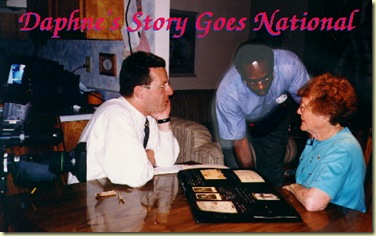
NBC Nightly News producer Eric Wishnie waits as sound man Johnny Scott clips a microphone to Daphne's collar. Wishnie, Scott and cameraman Mike Stephen traveled to Lebanon, Ind., May 19 to include Daphne in Tom Brokaw's Home of the Brave series on Nightly News. It aired May 22, 1998.
This story appeared in the May 22, 1998 Metro North section of The Star & The News
By John M. Flora
STAFF WRITER
LEBANON, Ind. – Daphne Cavin's story of young love cut short by World War II will be featured on NBC Nightly News tonight.
Daphne was married just 26 months when her young husband, Raymond Kelley, died in combat in France in September 1944.
The 78-year-old Lebanon woman shared her scrapbook, memories and heartbreak with a reporter from The Star & The News for a story published in the Feb. 13 Metro North section of the papers.
A few weeks ago, that story came to the attention of Eric Wishnie, a producer for NBC Nightly News in New York.
Wishnie had been assigned by Nightly News anchor Tom Brokaw to find stories about the generation of Americans who came of age during World War II.
Using Lexis-Nexis, an electronic information service that accesses newspaper and magazine archives and other databases, Wishnie discovered Daphne's story and was charmed by it.
 It was also the perfect story to dovetail with Friday's scheduled dedication of a monument to World War II veterans in downtown Indianapolis. The ceremonies, which are part of the 500 Festival Memorial Service, will be attended by former presidential candidate and disabled World War II veteran Bob Dole and Gov. Frank O'Bannon.
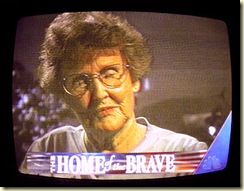
Wishnie and an NBC crew came to Lebanon Tuesday to interview Daphne for a segment to be narrated by Brokaw. Brokaw will be at the services Friday and will meet Daphne, her children and grandchildren.
“In the last 18 months or so, Nightly News has done about a dozen stories on the World War II generation,” Wishnie explained. “The idea is that this generation built America into what it is today and they never whined about what they had to go through. Now they're getting a little older and we don't pay enough mind to them...
“We don't spend enough time talking about the sacrifices people made who didn't go off to war – not just the worries they had about their spouses, but raising children on their own and working to keep up,” he said.
So, as NBC cameraman Mike Stephen and sound man Johnny Scott recorded the scene, Daphne spent much of Tuesday remembering what it was like to have a marriage with a young soldier – stealing a few days here and there during leaves and furloughs before he was shipped overseas.
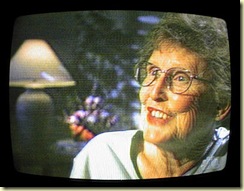 She lovingly showed the black-and-white photos of their wedding and their happy times together and she pointed with pride to Raymond's uniform patches combat infantryman's badge. And she sadly unfolded the brittle one-page Western Union telegram that carried the news of Raymond's death in France.
Daphne and Raymond had no children. She married Marvin Cavin, a Boone County farmer, in 1950, and they had two daughters and twin sons. In 1974, when Cavin was beginning to think about retirement from the Boone County Farm Bureau Co-op, he was diagnosed with cancer. He died less than a year later.
“I would have loved to have been able to retire with him,”' Daphne said. “It was a big disappointment. But I was disappointed when no one came home from the war, too.”
Wishnie, whose job it is to piece together the three-minute segment he expects will air at the end of tonight's newscast, said Wednesday he was touched by Daphne's willingness to share such intimate bittersweet memories.
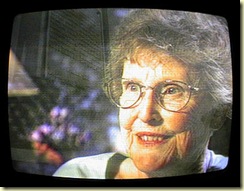 “I just hope I can do justice to her story,” he said from his New York office.
“This all makes me feel rather humble,” Daphne said. “I'm overwhelmed by the attention. I think my children are getting more of a kick out of this than I am. They think it's wonderful.
“I just think people are going to get sick of hearing about me,” said Daphne. “There's nothing special about me. I'm just one of the many.”
The Story Behind the Story
Daphne Cavin first phoned me sometime shortly after Christmas, 1997. She explained that a group of French students from Zionsville, Ind., had visited the grave of her first husband, Raymond Kelley, during a class trip to France the previous spring. She had been hoping for a small story in her local newspaper, The Lebanon Reporter, to recognize the Zionsville kids for their thoughtful gesture in memory of the only Boone County serviceman believed buried in the Allied cemetery at Epinal.
She had been in touch with a young reporter named Danielle Gates, a granddaughter of Mamie Gates, who had introduced Daphne and Raymond back in the summer of 1941. She gave Danielle some of the photos taken by the Zionsville student group and waited for the story to appear. Finally, late in 1997, Danielle left the Lebanon paper for a newspaper job in Kokomo, Ind. She hadn't written the story and she didn't return the photos. It was clear she'd blown Daphne off.
“Do you think this would make a story?” Daphne asked me on the phone that winter afternoon.
I turned the thing over in my mind. The pictures from the cemetery visit were now more than six months old. We'd lost our news peg upon which to hang any story about the Zionsville kids. I had no idea where this story was going and how I could make the Metro North reader believe it was news. We weren't close enough to Memorial Day or Veterans Day for a seasonal tie-in, but I felt there was something here. I wanted to hear Daphne's story.
I finally got to Lebanon to meet Daphne around the first week of February. She welcomed me into the home she shares with her daughter and granddaughter and we sat down at their dining room table to go through her scrapbook. It only took about a minute for me to realize that the Zionsville kids weren't the story. Daphne was the story.
I was at once fascinated and charmed by this woman and her love for both of her husbands. I was honored when she told me of the dream around the time of Raymond's death when he came to her and wordlessly comforted her, especially when she said she'd never told anyone else about that dream, not even her children. She asked me not to mention the dream in my story.
A few days later, as I wrote the story, I realized I had to mention the dream. I phoned Daphne and asked permission to include it. Her acquiescence was as good as getting a raise.
I was humbled to learn that much of what Daphne shared with me that afternoon, she had never told her own children. I worried that they might be upset seeing this stuff in print and Daphne wisely had the same concerns. Over the next day or so, she spoke with her two sons and two daughters and told them all the things she had never before mentioned about her first love. I like to think our interview helped bring her family a little closer together and gave her children and grandchildren a deeper appreciation of this remarkable woman.
My greatest disappointment about my story is that it never ran in the regular editions of The Star & The News, appearing only in a section that goes to the three north suburban counties of the Metropolitan Indianapolis area.
Even so, I know Daphne was very pleased with the story. She called me several times after it ran to thank me and to say how many people – old friends and complete strangers – had mentioned seeing it.
So when I learned Tom Brokaw was interested in Daphne's story, I was delighted. I was invited to the taping at Daphne's home. I was pleased to see producer Eric Wishnie had the same respect for her story as I. Eric and his crew spent about seven hours working with Daphne and her family and, when the final product aired three nights later, it was clear that Eric had truly connected with Daphne and crafted a wonderful story that her family will treasure forever.
Some writers feel territorial about stories like this. But, as I told Eric, this is really Daphne's story and we're just taking turns telling it. I'm honored to have had the chance to share this woman's humanity with my readers.
The Saga Continued:
Daphne gets four pages in a #1 bestseller
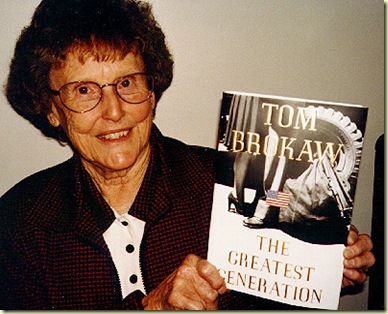
Daphne's story is in Brokaw's book
By John M. Flora
STAFF WRITER
LEBANON, Ind. – This has been a year of celebrity and a year of healing for Daphne Cavin.
The spotlight of public attention fell on the 79-year-old Lebanon woman last February when the Metro North section of The Star and The News carried the poignant story of her short-lived wartime marriage to Raymond Kelley.
The attention intensified when the Metro North story came to the attention of NBC Nightly News anchor Tom Brokaw, leading to Daphne being featured in a Nightly News “Home of the Brave” segment. Brokaw came to Indianapolis to attend the Memorial Day dedication of a World War II veterans monument with Daphne.
He also included her in his new book about the World War II generation, The Greatest Generation. The book, released in time for the 1998 Christmas market, is leading several best-seller lists.
Raymond Kelley left his young bride a widow when he died in September 1944. A private first class in the 45th Infantry Division, Kelley was killed by an artillery shell burst as his unit prepared to take the town of Mancrenans in southern France. Daphne kept a scrapbook of mementos of her time with Raymond, but gave it to her sister for safekeeping in 1950 when she married Marvin Cavin, a Boone County farmer. She and Marvin had four children – daughters Janie and Nancy and twin sons Oren and Loren. They were looking forward to Marvin's retirement in 1974 when he was diagnosed with cancer. He died in March 1975. Soon after Marvin's funeral, Daphne learned her second husband's death re-qualified her for Raymond's World War II survivor's benefits.
“I could hardly believe it. There I was at the age of 55 having to make my own living again,” she said, adding the unexpected benefit started at about $200 a month and now is more than $800 a month. “I guess you could say that Raymond is still taking care of me after all of these years,” she said.
Before she shared her story with a Metro North reporter, Daphne hadn't told her children much about her first marriage. “I might have made a mistake not telling my children much about Raymond, but I didn't want it rubbed in on my children. I didn't talk to them about it because of their feelings for their dad.”
“When the story came out, it made me realize that they really were interested in it,” she said, adding that talking about Raymond eases the pain she still feels. “I can talk about it now, whereas five or six years ago I couldn't,” she said. “I realized I can open up and let all those feelings out.
“Five or six years ago, I would have had problems reading this book,” she said, holding the personal copy she received from Brokaw. While she likes the book, which uses four pages and five pictures to tell her story, she observed, “There are a few salty words in it. I'm kind of naive. I'm just not used to that.”
The frontispiece of the book bears the hand-written inscription: “Daphne, I loved telling the story of your first love. Tom Brokaw”
“This has been a really nice lift for her at this point in her life,” said daughter Janie Strawmyer, who is understandably proud of her mother's unexpected fame. “She takes it really humbly because other people have suffered a lot of hardships in their lives too. She stayed strong through her life and has been a good example for us children. Her faith keeps her going and I see that in my life, too.”
Daphne may return to network television in January. NBC producer Eric Wishnie, who produced Daphne's “Home of the Brave” segment in May, said NBC plans an hour-long documentary featuring eight or ten characters from Brokaw's book. He said there is a chance some of the footage from his piece on Daphne will be included. The special is scheduled to air Jan. 15, he said.
New York Times reviewer
Finds Daphne's story
“Most moving” in book
Michael Lind, Washington editor of Harper's Magazine and a senior  fellow at the New American Foundation, reviewed The Greatest Generation in the Dec. 27, 1998, New York Times Book Review.
He takes exception with some of Brokaw's historical conclusions but writes, “Perhaps the most moving story is that of Daphne Cavin, a beautician in Lebanon, Ind., whose husband, Raymond Kelley, went to war only months after their marriage and was killed in France in June 1944 at the age of 22...”
Brokaw's Best Seller Links Daphne
With A Buddy Who Was There
When Raymond Was Killed
This story appeared in The Indianapolis Star
On Christmas Eve, 1999
By John M. Flora
STAFF WRITER
LEBANON, Ind. – Daphne Cavin, whose story of young love cut short by World War II was included in Tom Brokaw's best-selling The Greatest Generation, is sleeping easier now.
Daphne, 80, had only been married to Raymond Kelley 26 months when he was killed in action in September, 1944. A private first class in the 45th Infantry Division, Kelley was killed as his unit prepared to take the town of Mancrenans in southern France.
With only the terse War Department telegram and a letter from her young husband's sergeant, Daphne knew precious little about the circumstances of Kelley's death. She pushed it to the back of her mind through a second marriage and the raising of four children, but the ache of not knowing how her first love died was always there.
Second husband Marvin Cavin died of cancer in 1975. Shortly after his death, she retrieved a scrapbook of her life with Kelley that she'd given to her sister for safekeeping when she married Marvin in 1950. As she turned the pages and gazed at the photos of that young red-haired Lebanon beautician and her handsome soldier, the memories flooded back. But until this month, she never knew the details of how she became a war widow. “I'd always wondered how he felt about being over there, whether he was unhappy or felt alone,” she said.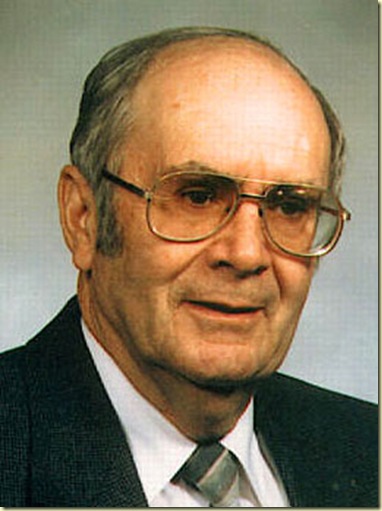
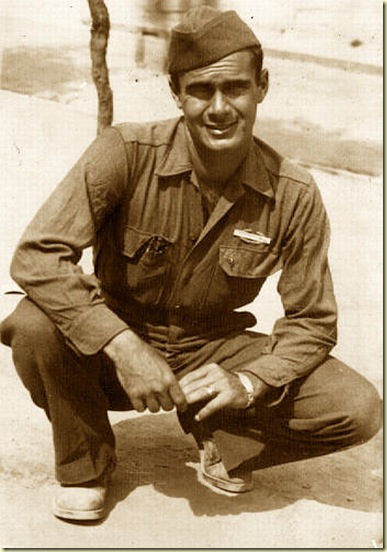
A.C. Clark today and as a combat rifleman in Italy in 1944.
Then, three weeks ago, she got a letter from A.C. Clark – forwarded to her by Brokaw's staff. Clark, 77, Cookeville, Tenn., wrote to Brokaw to thank him for writing The Greatest Generation and wondered if Daphne would like to talk to one of her husband's buddies who was on patrol with him when he was killed. Daphne called Clark at his home about 80 miles east of Nashville the afternoon of Dec. 10.
“I'd always wanted to contact her,” said Clark, a retired agricultural extension service agent who also served two years as Tennessee commissioner of agriculture. “But I figured that maybe she'd married again and I didn't want to disrupt anything and bring back old memories. It was a good many years before I felt like I wanted to talk about all these things myself. I was sorry I didn't get in touch with her, but I just didn't know what to do about it.”
Clark said he was leafing through a friend's copy of The Greatest Generation when “there was Raymond's picture. It just fell open there.”
“I thought, ‘Here's a fellow I was with when he got killed.’ I got to thinking I would like to tell her what I knew. I wondered if she knew how he died,” he said.
Clark remembers it was a warm sunny day as he and Kelley were among 35-40 men in two platoons deployed on a hillside. The men of the 45th Division were pushing up the Rhone River valley as the Germans fought a delaying action. The G.I.s were spread out, about 15-20 feet apart, keeping an eye on the ridge above them where they thought the enemy might be waiting.
Just then, Clark said, “This German half-track came around the bottom of the hill and sprayed the hillside with machine gun fire. We thought they would be up on the ridge and everybody was looking the other way. They came through about 15-20 mph and just sprayed the hillside and kept on going.”
Clark thinks the Germans may have been cut off by the advancing American troops and were making a dash for their own lines. “The thing that always stuck in my mind was seeing Raymond lying there when we had just been talking 30 minutes before,” he said.
“I remember seeing Raymond's wedding ring on his finger and I wondered if the Graves Registration Service would ever get it back to his family,” he said. “I have no idea who was standing there with me, but he said, ‘Should we take it?’
“But we decided we might be in his shape tomorrow and we'd lose it for sure then if it was sent back to our folks and they wouldn't know whose it was,” he said. Clark said he'd known Kelley about three or four months, having met the Boone County soldier when the 45th Division was fighting in Italy.
“He was a fine man and I told her this,” he said of his first conversation with Daphne. “I didn't know whether she knew this, but they were after some of us older PFCs to take a promotion to staff sergeant and take over a platoon.”
“Most of us felt like we didn't want the responsibility,” he said, recalling a popular expression about the hazards of being a leader: “Staff today, stiff tomorrow.”
“Raymond had decided to take a platoon, but his sergeant rank didn't come through in time,” he said. “He was to be made a staff sergeant the day after he was killed.”
That was an important detail for Daphne, who recalled Raymond came to her in a dream about the time he was killed. Without speaking, she said, he took her into his arms and held her as if to comfort her.
“I can remember feeling his hands on my back,” she said, recalling she was confused because he was dressed as an officer in the dream. She said she got a little chill when Clark told her about Kelley's impending promotion. Even though a sergeant is not an officer, she said, Kelley's appearance in the dream did suggest a promotion.
Clark saw his share of death in 180 days of combat. “I got to looking last night in my 45th Division History at the list of people who were killed and I counted a little over 100 men I knew personally,” he said, adding Raymond Kelley was one of just a few he felt he knew well.
“From the time I started with the outfit in Italy until I left it in France, their mailman told me over 1,000 men went through our 180-man company,” he said. “They didn't want you to get too close to the other men. It just hurt that much worse when they got killed.”
Daphne said her conversation with Clark feels like an early Christmas present. “I feel at peace,” she said. “For 56 years I had wondered if he was staying happy like he always was at home, if the Germans got his body... And I just thought it would be so wonderful if I could just talk to somebody who knew him over there.
“Then, all of a sudden there's this book and Mr. Clark read the book and all of a sudden, I've done it,” she said. “I feel a completeness that I just can't describe. I feel more at peace than I ever have.”
Daphne's Story Helps Other War Widows
Get Long-Overdue Survivor Benefits
By John M. Flora
STAFF WRITER
There's no doubt The Greatest Generation struck a resonant chord. The book was number 2 on this week's New York Times best seller list for hardcover non-fiction after 53 weeks on the list. It also spawned a second volume of stories, published this month by Tom Brokaw under the title The Greatest Generation Speaks.
 The new book, which premiered at number 5 on this week's New York Times best seller list, grew out of letters written by readers of last year's book. Brokaw said he was unprepared for the avalanche of letters and responses touched off by The Greatest Generation.
“I had written a book about America and now America was writing back,” he said.
Brokaw's homage to the World War II generation changed Daphne Cavin's life and touched innumerable others. Besides putting her in touch with a Tennessee veteran who was there when her husband was killed in combat, the re-telling of her story in The Greatest Generation has let her help other war widows.
It's a poignant fact that, although he died 56 years ago, Raymond Kelley is still taking care of his bride through his survivor benefits.
When Daphne married Marvin Cavin in 1950, she stopped receiving benefits. When Marvin died in 1975, she learned through a friend that she was once more eligible to receive Raymond's survivor benefits.
“I could hardly believe it. There I was at the age of 55 having to make my own living again,” she said. The payments started at about $200 a month and now amount to $861 a month.
Several of Brokaw's readers noticed that detail and contacted Daphne for more information. Among those inquiring was Jeannette Gagne Norton, another war widow whose story is in The Greatest Generation.
“I told her how to apply,” Daphne said. “It didn't take too long – a month or so – and she called me back and said, ‘I just got my first check’”
“You don't have any idea how much that helped me,” said Norton, who lives in a suburb of Minneapolis.
“I'd been living on my second husband's Social Security and was just squeaking by. If it hadn't been for her (Daphne's) story, I never would have known.” Norton's husband PFC Camille Gagne was in the 82nd Airborne Division. He survived combat in Italy and D-Day in France, but was killed defending the Nijmegen bridge in the ill-fated Allied invasion of Holland.
Shipped overseas two weeks after their son, Robert, was born, he died without ever seeing his child. Her second husband, William Norton, died in 1993. Last March, she said, she received a “huge check” representing a retroactive payment of benefits and monthly checks that will increase to $881 in January. Daphne said there have been other similar contacts. ``Another woman in Virginia who read the book, got my number from ‘information’ and called me about the benefits and, when she got her first check, she wrote back to tell me,” she said.
“It just makes me feel good to know my story is helping people.”


