My wife is pissed at me.
It's because I've spent an inordinately large amount of time this weekend on a new toy.
You may recall from an earlier post that I bemoaned the fact that I was deprived of web access for extended periods when I was on my three-week motorcycle ride through the West in July. I opined at that time that it would be nice to have a PDA with WiFi capabilities - something that would let me e-mail and blog from the road without hauling around a notebook computer.
Recently, I discovered a possibly more elegant solution - the PalmOne Treo family of PDA/cell phones. The premier model at the moment is the Treo 600, which combines the functions of a cell phone, PDA and digital camera. It also costs about $600.
The model it displaced, the Treo 300, has no camera and a bit less memory, but it does most of the same stuff.
I started poking around on Ebay looking for used Treos and found one with a Buy It Now price of $70. How could I go wrong? So I bought it on Thursday and, thanks for the magic of PayPal and the U.S. Postal Service Priority Mail, it showed up in my mailbox yesterday.
Since I've never even worked a PDA, this involved a fairly steep learning curve (which I am still ascending), learning to input information, puzzle out the HotSynch feature that links it with my PC, get Sprint to transfer my old cell phone number to the Treo 300, and on, and on.
This, of course, took a lot of time - time my wife thought I should be using in other pursuits.
The major benefit, as far as she is concerned, is that this frees up my old cell phone for use by her daughter, who is a sophomore in college this fall. With the proper Sprint calling plan, she can share in our pool of unlimited night and weekend minutes and talk until the microwaves fry her head.
My Treo being a used device, still had some of the previous owner's setting in place, which kept me from accessing the Web when it was activated yesterday.
So this afternoon, after I got my stepdaughter her own cell phone number, I hooked up with Sprint Tech Support to sort out the Web issue.
In order to get a signal, I had to take the Treo outside, talking to the techie on my cordless land line phone while I fiddled with the Treo.
Naturally, my neighbor chose this time to mow his lawn. He even felt generous enough to mow my lawn, which made an even louder racket while I was tying to peck my way through the various screen commands to get online. In the middle of all this, my dog Ruthie decided there was a dire threat in the neighborhood that required lots of loud barking.
I finally retreated into my car in the driveway as sort of an improvised phone booth and eventually got everything sorted out.
But not before my wife and her son threw me out of the car because they had to get to the hardware store before closing. My stepson, who is in a building trades class in his senior year of high school, had undertaken to install a new bathroom ceiling light fixture and needed a new junction box and some other stuff to finish the job.
Anyhow, the Treo 300 is now fully functional and my wife is sure I've wasted my weekend on something she considers utterly stupid.
I guess I'm glad she sees it that way. Otherwise, she'd probably want her own Treo.
Sunday, August 29, 2004

Friday, August 27, 2004
Another Mil-blog gone
Earlier this month, I directed anyone who stumbled in here to the blog of a U.S. soldier fighting with a Stryker unit in Mosul. The soldier identified himself as "CB" and wrote brilliant first-person accounts of firefights, patrols and day-to-day impressions of Iraq.
Before long, he was being read in the White House and the Pentagon as well as by folks like me. His commanding officer called him in one day a couple of weeks ago to compliment him on his writing and to caution him to be careful about including any details that might compromise operational security.
He was freaked out and concerned that he was now known to the upper echelons and was clearly on their radar screen.
He started being deliberately vague, "Today we went somewhere and did something," but his posts still had his distinctive voice and his observations were keen and compelling.
Then NPR got involved.
Reporter Eric Niiler did a piece on the Day to Day program that cast the Army in a very negative light vis a vis military bloggers. CB and the other soldier interviewed, a captain who also blogs from Iraq, weren't particularly pleased with the way the story was spun and said so online.
Now, today, CB's blog is no more. All of the previous content has been removed and the title, which morphed from "My War - Fear and Loathing in Iraq" to "My War," was changed today to "Over and Out."
I have lots of conflicting thoughts about what happened to CB and his blog and how his superiors tried to balance free speech against the safety of the troops and the success of the mission.
But as a professional journalist, I'm crystal clear on one thing: Eric Niiler betrayed the trust CB and the captain placed in him when they agreed to be interviewed.
I sent the following e-mail this morning to the Ombudsman at NPR:
I'm writing to complain about Eric Niiler's Aug. 24 piece about military bloggers in combat zones on Day to Day .
It's clear that the impetus for the story was the runaway popularity of a blog by a soldier in Mosul, Iraq who identified himself as "CB."
As a retired print journalist who has been following CB's blog for the last few weeks, I was angered and disturbed by Niiler's piece. Niiler obviously brought his own agenda to the story and turned it into a rant about Army persecution of bloggers.
The real story, of course, is the online public's enthusiastic response to what CB has been writing and how it's fresher and more genuine than anything we get from the mainstream media, including NPR. An honest reporter would have made that the central point of his story and explored the reasons why it is so.
As it turned out, Niiler doomed CB's blog by calling international attention to it and by divulging CB's name and unit.
I notice this morning that all of the previous content of CB's blog is gone and the name has been changed to "Over and Out."
It probably would have happened eventually, but Niiler's story made it a certainty.
That, in my judgment, is irresponsible journalism - using and abusing a source and distorting the reality of the situation just to have a sexier story.
At the same time, I recognize that once CB's superiors became aware of his blog, they had an obligation and a responsibility to make sure it was of no value to the enemy and did not endanger our troops. In that regard, I think they are right to err on the side of caution, even if it means silencing a voice many of us have come to admire and trust.
But the fact remains that Niiler put his own spin on the story and, in so doing, undermined the credibility of NPR. This is precisely why I and thousands like me search the internet for blogs from Iraq. The mainstream media, including NPR, isn't giving us the coverage we want.
Before long, he was being read in the White House and the Pentagon as well as by folks like me. His commanding officer called him in one day a couple of weeks ago to compliment him on his writing and to caution him to be careful about including any details that might compromise operational security.
He was freaked out and concerned that he was now known to the upper echelons and was clearly on their radar screen.
He started being deliberately vague, "Today we went somewhere and did something," but his posts still had his distinctive voice and his observations were keen and compelling.
Then NPR got involved.
Reporter Eric Niiler did a piece on the Day to Day program that cast the Army in a very negative light vis a vis military bloggers. CB and the other soldier interviewed, a captain who also blogs from Iraq, weren't particularly pleased with the way the story was spun and said so online.
Now, today, CB's blog is no more. All of the previous content has been removed and the title, which morphed from "My War - Fear and Loathing in Iraq" to "My War," was changed today to "Over and Out."
I have lots of conflicting thoughts about what happened to CB and his blog and how his superiors tried to balance free speech against the safety of the troops and the success of the mission.
But as a professional journalist, I'm crystal clear on one thing: Eric Niiler betrayed the trust CB and the captain placed in him when they agreed to be interviewed.
I sent the following e-mail this morning to the Ombudsman at NPR:
I'm writing to complain about Eric Niiler's Aug. 24 piece about military bloggers in combat zones on Day to Day .
It's clear that the impetus for the story was the runaway popularity of a blog by a soldier in Mosul, Iraq who identified himself as "CB."
As a retired print journalist who has been following CB's blog for the last few weeks, I was angered and disturbed by Niiler's piece. Niiler obviously brought his own agenda to the story and turned it into a rant about Army persecution of bloggers.
The real story, of course, is the online public's enthusiastic response to what CB has been writing and how it's fresher and more genuine than anything we get from the mainstream media, including NPR. An honest reporter would have made that the central point of his story and explored the reasons why it is so.
As it turned out, Niiler doomed CB's blog by calling international attention to it and by divulging CB's name and unit.
I notice this morning that all of the previous content of CB's blog is gone and the name has been changed to "Over and Out."
It probably would have happened eventually, but Niiler's story made it a certainty.
That, in my judgment, is irresponsible journalism - using and abusing a source and distorting the reality of the situation just to have a sexier story.
At the same time, I recognize that once CB's superiors became aware of his blog, they had an obligation and a responsibility to make sure it was of no value to the enemy and did not endanger our troops. In that regard, I think they are right to err on the side of caution, even if it means silencing a voice many of us have come to admire and trust.
But the fact remains that Niiler put his own spin on the story and, in so doing, undermined the credibility of NPR. This is precisely why I and thousands like me search the internet for blogs from Iraq. The mainstream media, including NPR, isn't giving us the coverage we want.
Thursday, August 26, 2004
Thank you, NPR
This is an open letter to the programming geniuses at National Public Radio who decided to kick Bob Edwards off of the Morning Edition program he has hosted since it began nearly 25 years ago.
Thank you.
You have made my flight from NPR immeasurably easier and more pleasant.
You see, I have been an NPR listener most of my adult life. Passengers in my car would put up howls of protest when I insisted on learning something from my radio rather than being “entertained” by music I don’t like and harassed by hours of commercial messages.
Earlier this summer, I became an XM Satellite Radio listener, even though they had little or no programming of the type carried by NPR. That was the one shortcoming that kept me sneaking back to my local NPR stations.
The programmers at XM must have noticed this deficit as well, because they recently announced the Sept. 1 launch of XM Public Radio – a channel with much of the same programming carried by NPR.
Like, for instance:
From PRI:
• American Routes
• Mountain Stage
• Riverwalk Jazz
• Sounds Eclectic
• PRI's Studio 360
• This American Life
From American Public Media Programming:
• American RadioWorks
• As It Happens
• The Writer's Almanac
From WBUR:
• The Connection
• Here and Now
• On Point
• Only a Game
And the crown jewel in their lineup, starting Oct. 4, The Bob Edwards Show every weekday morning. Thanks to your shabby treatment, Bob Edwards has a far more promising future in public broadcasting than the arrogant fools who canned him.
Now XM has everything I want in a radio experience – a nearly infinite variety of commercial-free music and all the best of NPR without those excruciatingly tedious local fund-raising campaigns.
Thank you, NPR.
Thank you.
You have made my flight from NPR immeasurably easier and more pleasant.
You see, I have been an NPR listener most of my adult life. Passengers in my car would put up howls of protest when I insisted on learning something from my radio rather than being “entertained” by music I don’t like and harassed by hours of commercial messages.
Earlier this summer, I became an XM Satellite Radio listener, even though they had little or no programming of the type carried by NPR. That was the one shortcoming that kept me sneaking back to my local NPR stations.
The programmers at XM must have noticed this deficit as well, because they recently announced the Sept. 1 launch of XM Public Radio – a channel with much of the same programming carried by NPR.
Like, for instance:
From PRI:
• American Routes
• Mountain Stage
• Riverwalk Jazz
• Sounds Eclectic
• PRI's Studio 360
• This American Life
From American Public Media Programming:
• American RadioWorks
• As It Happens
• The Writer's Almanac
From WBUR:
• The Connection
• Here and Now
• On Point
• Only a Game
And the crown jewel in their lineup, starting Oct. 4, The Bob Edwards Show every weekday morning. Thanks to your shabby treatment, Bob Edwards has a far more promising future in public broadcasting than the arrogant fools who canned him.
Now XM has everything I want in a radio experience – a nearly infinite variety of commercial-free music and all the best of NPR without those excruciatingly tedious local fund-raising campaigns.
Thank you, NPR.

Bad hair
My wife got a bad haircut yesterday.
For the last few months, she's had a kind of bob cut - visualize, if you can, the tragic self-destructive Sophie, played by Theresa Russell, in the Bill Murray version of The Razor's Edge.
She was tired of the look and gave her hairdresser instructions that she wanted a different look. Her goal was longer hair, but somehow she and the hairdresser thought they could achieve this "longer" look by cutting hair.
Oh, really?
So he squared off the sides and poofed up the top, taking her from a low/no maintenance hairdo to one that requires blowdryer teasing on the top every morning. This, she says, will assure that she looks like crap after wearing a motorcycle helmet or anything else that will smash it down.
If I were looking for an example of the differences between men and women, I doubt I could find a better one.
Most men's attitude about hair is best summarized by the BMW motorcycle ad showing a guy with tousled, tangled hair and the caption, "I have a new hair stylist. His name's Helmet."
If you frisked every man in America, I'm willing to bet you'd find that fewer than 15% are packing a comb. Most of us just do a "finger comb," running our hand through our hair to organize it in the general direction of a part.
When is the last time you saw advertising for Brylcreem or Vitalis or any other men's hair grease? We just don't care.
Got a bad haircut? So what? It'll grow out.
The last time I paid any attention to my hair was about 10 years ago when I wondered what it would be like to have dark hair. I was prematurely gray - completely silver gray by my late 30s. I asked my hairdresser at the time if it would be a big deal to dye it. Even though my original natural hair color was brown, we decided to go for drama and we dyed it black - about the same shade of black as my Korean hairdresser's tresses. Of course, my beard got dyed too.
(Note to anyone considering this: Do not attempt a radical hair color change like this if you take yourself very seriously and don't have a good sense of humor.)
I spent the first week or so enjoying the startled look on my friends' faces. My ex dropped by during this period and burst out laughing when I opened my front door to her.
When I rode out to Oregon to visit my son that summer, I found he'd gone from natural brown to peroxide blond, so we both had a good chuckle when I pulled off my helmet in his driveway.
I kept the black hair through the summer, going back for maintenance every couple of weeks when the silver lining started to show. By autumn, I was tired of it and went through a few weeks of the skunk look until my hair was long enough to whack off all of the blackness.
Did I look younger? Yeah, I guess so. Did it improve my social life? Not particularly.
In retrospect, it was probably a hair blunder even worse than my wife's cut this week.
But I'm not about to pat her on the head and say, "There, there. It'll grow out eventually."
For the last few months, she's had a kind of bob cut - visualize, if you can, the tragic self-destructive Sophie, played by Theresa Russell, in the Bill Murray version of The Razor's Edge.
She was tired of the look and gave her hairdresser instructions that she wanted a different look. Her goal was longer hair, but somehow she and the hairdresser thought they could achieve this "longer" look by cutting hair.
Oh, really?
So he squared off the sides and poofed up the top, taking her from a low/no maintenance hairdo to one that requires blowdryer teasing on the top every morning. This, she says, will assure that she looks like crap after wearing a motorcycle helmet or anything else that will smash it down.
If I were looking for an example of the differences between men and women, I doubt I could find a better one.
Most men's attitude about hair is best summarized by the BMW motorcycle ad showing a guy with tousled, tangled hair and the caption, "I have a new hair stylist. His name's Helmet."
If you frisked every man in America, I'm willing to bet you'd find that fewer than 15% are packing a comb. Most of us just do a "finger comb," running our hand through our hair to organize it in the general direction of a part.
When is the last time you saw advertising for Brylcreem or Vitalis or any other men's hair grease? We just don't care.
Got a bad haircut? So what? It'll grow out.
The last time I paid any attention to my hair was about 10 years ago when I wondered what it would be like to have dark hair. I was prematurely gray - completely silver gray by my late 30s. I asked my hairdresser at the time if it would be a big deal to dye it. Even though my original natural hair color was brown, we decided to go for drama and we dyed it black - about the same shade of black as my Korean hairdresser's tresses. Of course, my beard got dyed too.
(Note to anyone considering this: Do not attempt a radical hair color change like this if you take yourself very seriously and don't have a good sense of humor.)
I spent the first week or so enjoying the startled look on my friends' faces. My ex dropped by during this period and burst out laughing when I opened my front door to her.
When I rode out to Oregon to visit my son that summer, I found he'd gone from natural brown to peroxide blond, so we both had a good chuckle when I pulled off my helmet in his driveway.
I kept the black hair through the summer, going back for maintenance every couple of weeks when the silver lining started to show. By autumn, I was tired of it and went through a few weeks of the skunk look until my hair was long enough to whack off all of the blackness.
Did I look younger? Yeah, I guess so. Did it improve my social life? Not particularly.
In retrospect, it was probably a hair blunder even worse than my wife's cut this week.
But I'm not about to pat her on the head and say, "There, there. It'll grow out eventually."
Friday, August 20, 2004

What I did in the war
Like John Kerry and Al Gore - two hollow frauds who I heartily detest - I was a member of the U.S. armed forces during the Vietnam War.
For 41 days.
I was a sophomore in college in 1965. I'd joined a fraternity and was working on the student newspaper and, as a consequence, couldn't be bothered with studying or going to class. So I flunked out.
Bad timing on my part, because that meant I lost my student deferment at a time when the war in Vietnam was heating up and more and more guys my age were being drafted.
The dean of students said I could come back, but I had to lay out a semester.
Since the draft pool in my small rural home county was rather shallow, that guaranteed I'd be drafted before I could get back into college.
So I took a job at an RCA TV and stereo cabinet factory and considered my options.
I talked with Army and Air Force recruiters and took the exam that's a prerequisite to becoming an Army officer. I've always been good at taking that kind of test, which is why I set the record for SAT scores at my high school. I did well on the Army officer test too and they were keen to have me join their team.
About this time, I became aware that the combat life expectancy of a second lieutenant is alarmingly short and my instinct for self-preservation kicked in.
I had a fleeting thought of escaping to Canada, as a lot of guys in my generation did, but I immediately realized I couldn't inflict that kind of embarrassment upon my parents and I was way too fond of being an American to change nationalities or become a fugitive.
Wanting to retain at least some control over my fate - after all, they were also drafting for the Marines at that time - I decided to enlist in the U.S. Air Force. I've worn eyeglasses since the third grade and realized my lack of vision and a college degree assured I'd never be a military pilot, so that meant four years as an enlisted man. The Air Force has no infantry, so I most likely wouldn't have to go tramping through jungles and rice paddies. Most likely, I'd end up with some gig like meteorology or maybe even working on a base newspaper.
So, on Sept. 22, 1965, I showed up at the induction center with suitcase in hand and swore to defend the United States against all enemies, foreign and domestic.
About 4 o'clock the next morning, I found myself stepping off of a bus in the dark with a couple of hundred other guys at Lackland AFB in San Antonio, Texas.
The next few hours are a bit of a blur. I remember being assigned to the 3703rd Basic Military Training Squadron (BMTS) and an upper bunk on the second floor of a wooden barracks building that had undoubtedly been home to tens of thousands of clueless enlistees before me.
Our drill sergeant was a black guy named Staff Sgt. Maxey. I mention he was black only because in the course of basic training I learned that a couple of guys in my flight were from Alabama and carried Ku Klux Klan membership cards in their wallets. Remember this was back when the civil rights struggle was still going on and racism wasn't as out-of-vogue as it is today.
I vividly remember the humiliating experience of having to pay 65 cents for a GI haircut. I also recall going through the Green Machine - a large building where we got our uniforms, underwear, towels, shoes and duffle bags. The guys working there would cast a practiced eye over you and toss you a shirt or pants or jacket that, more often than not, was a very good fit.
I was mildly surprised a week or so later to notice that new arrivals - pre-haircut and pre-uniform - looked odd to me and to the other guys in my flight. We called them "rainbows" because of their colorful civilian clothes.
Air Force basic turned out to be a breeze - at least for me, especially compared with fraternity pledgeship. Marching, which seemed to baffle a lot of guys, was second nature to me, since I'd carried a Sousaphone for four years in high school marching band and knew the commands backward and forward. We ran a rather unchallenging obstacle course, learned to shoot the old M1 carbine (I qualified as an expert marksman and actually won a ribbon), and spent hours in classrooms learning about the Uniform Code of Military Justice, Air Force organizational structure and a lot of other stuff I've since forgotten. They were out of tear gas the day we were supposed to go through the dreaded tear gas experience.
Early in basic training, we were photographed and fingerprinted for our military IDs and records. In the months before my enlistment, I'd worked as a hand sander at the cabinet factory - using sandpaper to smooth off sharp edges and to remove errant bits of wood glue. As a result, my fingerprints were almost non-existent. The guys in charge of the operation looked at me suspiciously and I'm not sure they believed I wasn't trying to hide my identity. Over the course of basic training, I was called back in on three occasions to be re-fingerprinted and I don't think they ever did get a decent set of prints.
About two or three weeks into basic, we were marched off to a building to be assigned a specialty to match our abilities. It was then that it was discovered the records of my physical exam at the induction center had been lost in transit. They need your physical exam records to assign you to a job in the Air Force. Like, for instance, they don't want to send someone who is colorblind off to electronics school where they won't be able to differentiate between red and green wires.
So I went for a Lost Records Physical, which was much more thorough than any physical exam being done at the induction centers. Remember, this was in 1965 when all of the induction centers across the nation had huge quotas to make. Their screening processes were accordingly less stringent.
So I checked the boxes for hay fever and some other allergies and childhood asthma - all true - got my eyes and hearing tested and went back to the barracks.
I got a call-back a day or two later to report to the allergy clinic at Wilford Hall Air Force Hospital, over on the other side of the base. There, I was given a series of 26 subcutaneous injections of all kinds of stuff - cottonwood pollen, house dust, ragweed, cat dander. I got a reaction to everything, including the distilled water control injection. The allergist was calling people in from the hallway to look at my arm - it was the most dramatic reaction he'd ever seen. I suspected this was an important event, but nothing came of it right away.
Near the end of basic, I got a message to report to a panel of four doctors, all of them captains.
Captain: "Do you plan to make a career of the Air Force?"
Me: "No, sir. I just wanted to get my time out of the way."
Captain: "Would you be upset if we sent you home?"
Me: "No, sir. I think I could handle it."
I was immediately transferred to a "casual" barracks populated by other guys being processed out of the Air Force - some for less savory reasons than medical issues. I turned in all of my uniforms and equipment, keeping only the PT (physical training) shirt and shorts and my underwear and I remember signing a waiver that stipulated that I would never apply for veteran's benefits.
Ten days later, I was winging my way home on a Braniff Airlines jet.
The date was Nov. 2, 1965.
My draft board re-classified me as 1-Y, which moved me waaaaay down the list of draft eligibility, and I went back to college the following January.
Do I regret accepting their offer to return to civilian life?
No.
But, at the same time, I'm haunted by a nagging feeling that I missed out on the Great Adventure of my generation. That feeling goes away quickly when I talk to 'Nam vets whose post-war lives have been a hell of alcohol and drug abuse, Agent Orange illness and the consequences of combat stress.
I thank God that my life has been as easy as it has and I thank them for what they endured out of a sense of duty and honor.
I visited the Vietnam Memorial in Washington, D.C., a few years ago. I realized I don't know a single person whose name is etched on those black marble tablets, but I was keenly aware that but for a stroke of luck, my name could be up on that wall.
I have enormous respect for every man and woman who served honorably in Vietnam.
But I have only contempt for those who exaggerate or lie about their service to advance their 21st century political ambitions.
For 41 days.
I was a sophomore in college in 1965. I'd joined a fraternity and was working on the student newspaper and, as a consequence, couldn't be bothered with studying or going to class. So I flunked out.
Bad timing on my part, because that meant I lost my student deferment at a time when the war in Vietnam was heating up and more and more guys my age were being drafted.
The dean of students said I could come back, but I had to lay out a semester.
Since the draft pool in my small rural home county was rather shallow, that guaranteed I'd be drafted before I could get back into college.
So I took a job at an RCA TV and stereo cabinet factory and considered my options.
I talked with Army and Air Force recruiters and took the exam that's a prerequisite to becoming an Army officer. I've always been good at taking that kind of test, which is why I set the record for SAT scores at my high school. I did well on the Army officer test too and they were keen to have me join their team.
About this time, I became aware that the combat life expectancy of a second lieutenant is alarmingly short and my instinct for self-preservation kicked in.
I had a fleeting thought of escaping to Canada, as a lot of guys in my generation did, but I immediately realized I couldn't inflict that kind of embarrassment upon my parents and I was way too fond of being an American to change nationalities or become a fugitive.
Wanting to retain at least some control over my fate - after all, they were also drafting for the Marines at that time - I decided to enlist in the U.S. Air Force. I've worn eyeglasses since the third grade and realized my lack of vision and a college degree assured I'd never be a military pilot, so that meant four years as an enlisted man. The Air Force has no infantry, so I most likely wouldn't have to go tramping through jungles and rice paddies. Most likely, I'd end up with some gig like meteorology or maybe even working on a base newspaper.
So, on Sept. 22, 1965, I showed up at the induction center with suitcase in hand and swore to defend the United States against all enemies, foreign and domestic.
About 4 o'clock the next morning, I found myself stepping off of a bus in the dark with a couple of hundred other guys at Lackland AFB in San Antonio, Texas.
The next few hours are a bit of a blur. I remember being assigned to the 3703rd Basic Military Training Squadron (BMTS) and an upper bunk on the second floor of a wooden barracks building that had undoubtedly been home to tens of thousands of clueless enlistees before me.
Our drill sergeant was a black guy named Staff Sgt. Maxey. I mention he was black only because in the course of basic training I learned that a couple of guys in my flight were from Alabama and carried Ku Klux Klan membership cards in their wallets. Remember this was back when the civil rights struggle was still going on and racism wasn't as out-of-vogue as it is today.
I vividly remember the humiliating experience of having to pay 65 cents for a GI haircut. I also recall going through the Green Machine - a large building where we got our uniforms, underwear, towels, shoes and duffle bags. The guys working there would cast a practiced eye over you and toss you a shirt or pants or jacket that, more often than not, was a very good fit.
I was mildly surprised a week or so later to notice that new arrivals - pre-haircut and pre-uniform - looked odd to me and to the other guys in my flight. We called them "rainbows" because of their colorful civilian clothes.
Air Force basic turned out to be a breeze - at least for me, especially compared with fraternity pledgeship. Marching, which seemed to baffle a lot of guys, was second nature to me, since I'd carried a Sousaphone for four years in high school marching band and knew the commands backward and forward. We ran a rather unchallenging obstacle course, learned to shoot the old M1 carbine (I qualified as an expert marksman and actually won a ribbon), and spent hours in classrooms learning about the Uniform Code of Military Justice, Air Force organizational structure and a lot of other stuff I've since forgotten. They were out of tear gas the day we were supposed to go through the dreaded tear gas experience.
Early in basic training, we were photographed and fingerprinted for our military IDs and records. In the months before my enlistment, I'd worked as a hand sander at the cabinet factory - using sandpaper to smooth off sharp edges and to remove errant bits of wood glue. As a result, my fingerprints were almost non-existent. The guys in charge of the operation looked at me suspiciously and I'm not sure they believed I wasn't trying to hide my identity. Over the course of basic training, I was called back in on three occasions to be re-fingerprinted and I don't think they ever did get a decent set of prints.
About two or three weeks into basic, we were marched off to a building to be assigned a specialty to match our abilities. It was then that it was discovered the records of my physical exam at the induction center had been lost in transit. They need your physical exam records to assign you to a job in the Air Force. Like, for instance, they don't want to send someone who is colorblind off to electronics school where they won't be able to differentiate between red and green wires.
So I went for a Lost Records Physical, which was much more thorough than any physical exam being done at the induction centers. Remember, this was in 1965 when all of the induction centers across the nation had huge quotas to make. Their screening processes were accordingly less stringent.
So I checked the boxes for hay fever and some other allergies and childhood asthma - all true - got my eyes and hearing tested and went back to the barracks.
I got a call-back a day or two later to report to the allergy clinic at Wilford Hall Air Force Hospital, over on the other side of the base. There, I was given a series of 26 subcutaneous injections of all kinds of stuff - cottonwood pollen, house dust, ragweed, cat dander. I got a reaction to everything, including the distilled water control injection. The allergist was calling people in from the hallway to look at my arm - it was the most dramatic reaction he'd ever seen. I suspected this was an important event, but nothing came of it right away.
Near the end of basic, I got a message to report to a panel of four doctors, all of them captains.
Captain: "Do you plan to make a career of the Air Force?"
Me: "No, sir. I just wanted to get my time out of the way."
Captain: "Would you be upset if we sent you home?"
Me: "No, sir. I think I could handle it."
I was immediately transferred to a "casual" barracks populated by other guys being processed out of the Air Force - some for less savory reasons than medical issues. I turned in all of my uniforms and equipment, keeping only the PT (physical training) shirt and shorts and my underwear and I remember signing a waiver that stipulated that I would never apply for veteran's benefits.
Ten days later, I was winging my way home on a Braniff Airlines jet.
The date was Nov. 2, 1965.
My draft board re-classified me as 1-Y, which moved me waaaaay down the list of draft eligibility, and I went back to college the following January.
Do I regret accepting their offer to return to civilian life?
No.
But, at the same time, I'm haunted by a nagging feeling that I missed out on the Great Adventure of my generation. That feeling goes away quickly when I talk to 'Nam vets whose post-war lives have been a hell of alcohol and drug abuse, Agent Orange illness and the consequences of combat stress.
I thank God that my life has been as easy as it has and I thank them for what they endured out of a sense of duty and honor.
I visited the Vietnam Memorial in Washington, D.C., a few years ago. I realized I don't know a single person whose name is etched on those black marble tablets, but I was keenly aware that but for a stroke of luck, my name could be up on that wall.
I have enormous respect for every man and woman who served honorably in Vietnam.
But I have only contempt for those who exaggerate or lie about their service to advance their 21st century political ambitions.
Thursday, August 19, 2004
Tuesday, August 17, 2004
Bucky who?
I visited our little postoffice this afternoon to mail a gift to my new granddaughter and it occurred to me that we could use more 37¢ stamps.
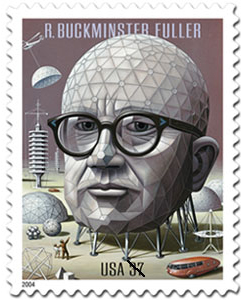
Responding to my request for "something interesting" in the way of stamps, our postmistress (Can you call a woman a postmaster?) whipped out an assortment of commemoratives - Olympics, Disney characters, Louisiana Purchase... and then offered a sheet of 20 depicting "some guy named Buckminster Fuller."
Some guy? Bucky Fuller is "some guy?"
Trying to control the incredulity in my voice, I patiently explained that R. Buckminster Fuller (1895-1983) was, among other things, the inventor of the geodesic dome. She had never heard of him.
I let it go at that and didn't bore her with the fact that I once met Bucky Fuller in the course of covering one of this lectures for my newspaper.
Fuller was one of the most brilliant men of the 20th century. He coined the word "synergy" and designed houses and cars that had qualities that actually made them so superior to what was then available as to be too advanced for public taste.
Checking the U.S. Postal Service website, I discovered the stamp was issued on July 12, which was the 50th anniversary of Fuller's patent on the geodesic dome. It would also have been his 109th birthday.
You can learn more about Bucky Fuller and his legacy at the Buckminster Fuller Institute website.
Responding to my request for "something interesting" in the way of stamps, our postmistress (Can you call a woman a postmaster?) whipped out an assortment of commemoratives - Olympics, Disney characters, Louisiana Purchase... and then offered a sheet of 20 depicting "some guy named Buckminster Fuller."
Some guy? Bucky Fuller is "some guy?"
Trying to control the incredulity in my voice, I patiently explained that R. Buckminster Fuller (1895-1983) was, among other things, the inventor of the geodesic dome. She had never heard of him.
I let it go at that and didn't bore her with the fact that I once met Bucky Fuller in the course of covering one of this lectures for my newspaper.
Fuller was one of the most brilliant men of the 20th century. He coined the word "synergy" and designed houses and cars that had qualities that actually made them so superior to what was then available as to be too advanced for public taste.
Checking the U.S. Postal Service website, I discovered the stamp was issued on July 12, which was the 50th anniversary of Fuller's patent on the geodesic dome. It would also have been his 109th birthday.
You can learn more about Bucky Fuller and his legacy at the Buckminster Fuller Institute website.
Slow touring
Five guys left Seattle a little more than a week ago, determined to take a Segway - one of those battery-powered scooters - across the country in 80 days or so.
They're calling their trip "America at 10 mph" and are documenting it online with text and videos at www.10mph.com.
As of today, they've covered 301.5 miles and are in Dayton, Wash.
The Segway needs a battery change about every hour and they've made 32 battery changes. The batteries take about 7 hours to recharge, so they have a support vehicle full of camera gear, the four non-riders and charging batteries creeping down the blue highways in search of America.
They say they've had 127 invitations to stay with people. At 10 mph on something as unusual as a Segway, you can't help but meet a lot of people.
They're calling their trip "America at 10 mph" and are documenting it online with text and videos at www.10mph.com.
As of today, they've covered 301.5 miles and are in Dayton, Wash.
The Segway needs a battery change about every hour and they've made 32 battery changes. The batteries take about 7 hours to recharge, so they have a support vehicle full of camera gear, the four non-riders and charging batteries creeping down the blue highways in search of America.
They say they've had 127 invitations to stay with people. At 10 mph on something as unusual as a Segway, you can't help but meet a lot of people.
Friday, August 13, 2004
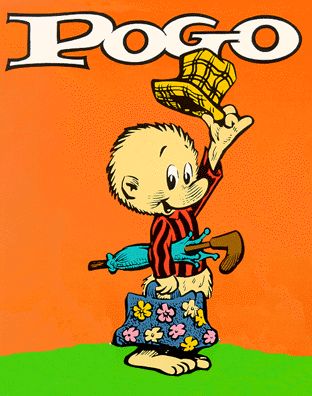
Today is Friday, the 13th. Whenever the 13th falls on a Friday, I always think of Walt Kelley's long-running (1948-73) comic strip, Pogo. The 13th got mentioned in the strip almost monthly, whether it fell on a Friday or not. The typical reference would have Pogo Possum or his friend Albert Alligator observing, "Friday the 13th came on a Tuesday this month." I suspect the short Pogo and the tall Albert were the models for Calvin and Hobbes many years later.

Thursday, August 12, 2004

Parting out an old friend
I've been taking advantage of the unseasonably cool weather this week to return to my otherwise beastly hot garage and take more parts off of my slowly disappearing '91 BMW K100RS.
As you may recall from previous posts, I'm parting it out on eBay to make payments on its replacement - an '03 K1200GT (which now has 18k on the odometer).
Today's project will be the draining, removal, cleaning, photographing and listing of the gas tank. It's the last painted part and the last clue that the bike was once a gorgeous pearl silver piece of mobile sculpture.
Disassembling this bike has been almost like butchering my own child. It's interesting how attached you can get to a motorcycle. A friend of mine had a similar attachment to a BMW he named "Old Blue." He crashed it on a Memorial Day Weekend club ride in Missouri several years ago and wrote a moving piece about the bike for the club newsletter. A few days later, another club member started ribbing him about his sentimentality, saying, "It's only a machine." My friend blew up, stomped out of the restaurant and nearly quit the club over it.
Here's what I wrote about my bike in 1997 when it turned 100,000 miles:
It never made it to 200k. In the middle of a four-week, 6,000-mile-plus ride to the West Coast in 2002, it developed a disturbing noise deep in the engine. I had it checked out by mechanics at the Santa Cruz, Calif., BMW shop and they opined it would probably get me home. My local dealer's chief wrench diagnosed the problem as disintegrating bushings in the output shaft. With 160,000 on the odometer, he said, the parts and labor would amount to more than the bike was worth. And when it was fixed, I'd still have a bike with 160k on the clock and God knows what other old parts getting ready to fail.
Clearly, it was time to retire the bike and buy another.
My dealer said I'd be lucky to get $2,000 out of the bike, so I decided to see if the sum of the parts was greater than the whole by parting it out on eBay. So far, I've made about $2,400 and I'm just now getting down to the mechanical stuff.
As you may recall from previous posts, I'm parting it out on eBay to make payments on its replacement - an '03 K1200GT (which now has 18k on the odometer).
Today's project will be the draining, removal, cleaning, photographing and listing of the gas tank. It's the last painted part and the last clue that the bike was once a gorgeous pearl silver piece of mobile sculpture.
Disassembling this bike has been almost like butchering my own child. It's interesting how attached you can get to a motorcycle. A friend of mine had a similar attachment to a BMW he named "Old Blue." He crashed it on a Memorial Day Weekend club ride in Missouri several years ago and wrote a moving piece about the bike for the club newsletter. A few days later, another club member started ribbing him about his sentimentality, saying, "It's only a machine." My friend blew up, stomped out of the restaurant and nearly quit the club over it.
Here's what I wrote about my bike in 1997 when it turned 100,000 miles:
I kept a promise to myself this year.
On June 24, 1991, when I rode my new pearl silver 1991 K100RS out of the dealer's parking lot, I vowed that one day I'd see the odometer turn over 100,000 miles.
I remember chuckling at the audacity of BMW to put an odometer on their K-bikes that would read so high: Most bikes are junk long before their odometers need a sixth digit. But I knew this bike could do 100 grand and lots more.
I really wasn't in the market for a new bike back in the spring of '91. I had 80,000 miles on my 1981 R100RS and still had big traveling plans for that elegant graphite twin that had shown me so much of the country. I figured I'd eventually replace it with another R100RS, since the RS riding position suits me so well.
One afternoon, just to humor my local dealer, I took one of his new 16-valve K100s out for a demo ride. In less than 15 minutes, I was utterly seduced by the power and the handling of the new K. As I headed back to the dealership, I was doing the math to buy one of these amazing machines.
Luckily, this seduction came at a time when my finances made the purchase possible and the new bike was soon mine.
A few weeks later, I headed west for a week in Breckenridge, Colo., with BMW Club friends and then on to the Top O' the Rockies Rally in Paonia, Colo., then down through southern Utah to the BMW MOA National Rally in Flagstaff.
I remember how proud I was riding into the rally at Flagstaff. Heads turned. Riders gathered around to ogle the bike whenever I stopped. This was, after all, the new flagship of the BMW line – the latest example of the legendary BMW engineering prowess.
In the intervening six years, the bike carried me through 31 states and two Canadian provinces.
We've climbed the highest paved road in the United States to the summit of Mount Evans and we've screamed across the Nevada desert at just under 150 mph.
It's performed reliably in temperatures ranging from 20 below zero to 115 above.
Together, we've carved twisties from Deal's Gap to Big Sur, endured savage Kansas crosswinds and Wyoming hailstones. We've split lanes in Los Angeles freeway rush hour traffic and passed solitary hours cruising the Natchez Trace and the Blue Ridge Parkway.
We've raced thunderstorms across Utah wastelands and probed California redwood forests so deep and dense it was dark at midday.
This magnificent machine has carried me across the Golden Gate and down Highway A1A to Key West and up the backbone of the Canadian Rockies from Banff to Jasper.
My memory is flooded with images from the saddle:
* Endless fields of North Dakota sunflowers at sunrise, each turning its golden face to the rising sun that warmed my back.
* The haunting tragic sadness of the Shiloh battlefield.
* Riding the white sands of Daytona Beach.
* The incredible intoxicating sweet aroma of desert flowers after a Wyoming thunderstorm.
* Mount Hood shining at the western end of the Columbia River Gorge.
* An unseen Ponderosa pine forest filling my helmet with fragrance as I rode into Flagstaff at midnight.
* The snow-clad majesty of the Colorado Rockies as I-70 ascends to the clouds west of Denver.
* The hellish sulfur pits of Yellowstone.
* Dodging rubber shrapnel as the car in front of me shredded a tire and veered to the median of a California freeway.
* Climbing to the snowy summit of Independence Pass before attacking the twisty road down to Aspen and lunch at the Woody Creek Tavern.
To be fair, there have been problems. This bike, like many of its generation, had chronic exhaust system problems. It liked to break welds between the header pipes and the muffler and did so in the summers of '92, '94 and '95. In the summer of '93, it broke a baffle in Nebraska. Each time, BMW replaced the $1,800 exhaust system under warranty. Finally, when a weld failed at Mount Rushmore in 1995 and BMW couldn't get a replacement to me quickly, I rode to California BMW at Mountain View and stepped up to a Staintune. A year later, the Staintune ripped itself apart 60 miles west of Oklahoma City. It was replaced under warranty with what was touted as a more robust version. A year later, the header pipe developed a spiral crack and was replaced under warranty in what proved to be the final fix.
The top end of the engine had a bad exhaust port and was replaced at 30,000 miles. I replaced the alternator in Portland, Ore., in 1996. The fan quit in Tennessee in October, 1997, shooting a geyser of coolant out of the right side cover.
When I took delivery of the bike, I only made two minor modifications – I added a front fender extension to protect the radiator and belly pan and I installed a luggage rack.
I love the clean, sculpted look of the bike and took care that subsequent tweaks preserved the look. I upgraded the headlight with a 100/80-watt bulb, added a Hyperlite flasher to the brake light, replaced the right bar end weight with a Wrist Rest cruise control, swapped the stock clock for a Fuel Plus clock/fuel calculator and replaced the wrung-out stock shock absorber with a Works shock. I also replaced the stock black saddlebags with custom painted matching pearl silver bags.
I estimate I've gone through 26 tires – 16 front and 10 rear – and filled the tank about 450 times.
I could go on to tally the quarts of oil and how much I've spent on service, but that's stuff for the bean counters.
And I hate bean counters.
So that's why, when 99,999 yielded to 100,000 at 5:10 p.m. Oct. 19, 1997, all I could think about was how rich in experience and spirit this fabulous machine has made me. It was, without question, the best deal I ever made.
Now, let's see how soon we can get to 200,000.
It never made it to 200k. In the middle of a four-week, 6,000-mile-plus ride to the West Coast in 2002, it developed a disturbing noise deep in the engine. I had it checked out by mechanics at the Santa Cruz, Calif., BMW shop and they opined it would probably get me home. My local dealer's chief wrench diagnosed the problem as disintegrating bushings in the output shaft. With 160,000 on the odometer, he said, the parts and labor would amount to more than the bike was worth. And when it was fixed, I'd still have a bike with 160k on the clock and God knows what other old parts getting ready to fail.
Clearly, it was time to retire the bike and buy another.
My dealer said I'd be lucky to get $2,000 out of the bike, so I decided to see if the sum of the parts was greater than the whole by parting it out on eBay. So far, I've made about $2,400 and I'm just now getting down to the mechanical stuff.

Wednesday, August 11, 2004
Concerned
While reading the blog of one of my occasional readers this week, I found a link to My War - Fear and Loathing in Iraq - a blog by a soldier who is a machinegunner in a Stryker unit in Mosul. The Stryker is an armored vehicle that runs on tires, rather than tank-style tracks, and is proving quite useful in the urban combat engagements our guys find themselves in in Iraqui cities these days.
The soldier, who goes by the name of CB, has been writing the most gripping, true-to-life first-person combat stuff to come out of this war - all under the cover of blogland anonymity. He's developed a huge audience, apparently reaching as far as the White House and the Pentagon.
Early this week, he got called into his battalion commander's office for a talk. Turns out the BC is a fan and wants CB to keep blogging, but asked that he run his posts past his platoon sergeant to make sure there is nothing in them that compromises operational security. Since the BC knows one of his guys is writing the blog, I believe he has a duty to make sure nothing gets onto the internet that could endanger the men or the mission, so I can't fault him for calling CB in for a chat.
CB is, understandably, freaked out by this development and, in his most recent post that described the encounter, left the question open as to whether he would continue blogging.
Being a journalist myself, I understand how intellectually stifling it is to have your words run through someone else's filter. I doubt the sergeant would censor CB unnecessarily, but I suspect this added step in the process kinda kills the spontaneity of the blog. He can no longer just go to the internet cafe, bash out an entry and post it. Now he has to include the sergeant in the loop, which probably would involve saving his post as a draft, getting a printout to run past the sergeant and then going back to the internet cafe to post the approved version. It's probably do-able, but it may make the process so laborious as to discourage posting.
At last glance, he's received more than 200 comments from readers - all of them supportive and most encouraging him to continue.
While his first duty is to the mission and the unit, I hope he can find a way to make this new arrangement work because it's our best window yet on what's going on over there.
The soldier, who goes by the name of CB, has been writing the most gripping, true-to-life first-person combat stuff to come out of this war - all under the cover of blogland anonymity. He's developed a huge audience, apparently reaching as far as the White House and the Pentagon.
Early this week, he got called into his battalion commander's office for a talk. Turns out the BC is a fan and wants CB to keep blogging, but asked that he run his posts past his platoon sergeant to make sure there is nothing in them that compromises operational security. Since the BC knows one of his guys is writing the blog, I believe he has a duty to make sure nothing gets onto the internet that could endanger the men or the mission, so I can't fault him for calling CB in for a chat.
CB is, understandably, freaked out by this development and, in his most recent post that described the encounter, left the question open as to whether he would continue blogging.
Being a journalist myself, I understand how intellectually stifling it is to have your words run through someone else's filter. I doubt the sergeant would censor CB unnecessarily, but I suspect this added step in the process kinda kills the spontaneity of the blog. He can no longer just go to the internet cafe, bash out an entry and post it. Now he has to include the sergeant in the loop, which probably would involve saving his post as a draft, getting a printout to run past the sergeant and then going back to the internet cafe to post the approved version. It's probably do-able, but it may make the process so laborious as to discourage posting.
At last glance, he's received more than 200 comments from readers - all of them supportive and most encouraging him to continue.
While his first duty is to the mission and the unit, I hope he can find a way to make this new arrangement work because it's our best window yet on what's going on over there.
Monday, August 09, 2004

Go read something important
Please don't waste another minute on my pathetic little self-absorbed blog until you've visited My War - Fear and Loathing in Iraq.
The author is a soldier in Mosul and he's writing the most gripping, real stuff I've seen out of this war.
Go to his blog. Now.
The author is a soldier in Mosul and he's writing the most gripping, real stuff I've seen out of this war.
Go to his blog. Now.
Sunday, August 08, 2004

The Flora Boys in the Swiss Army
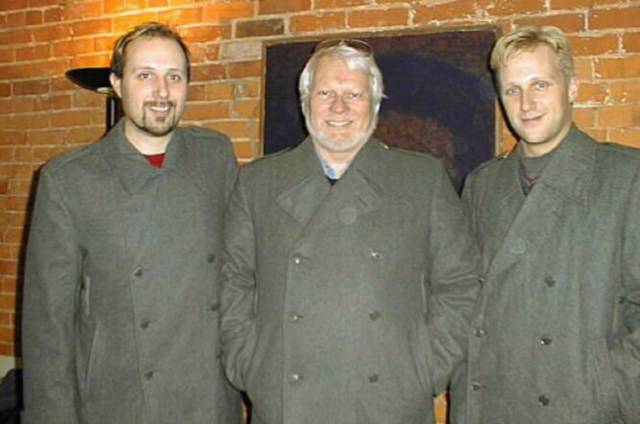
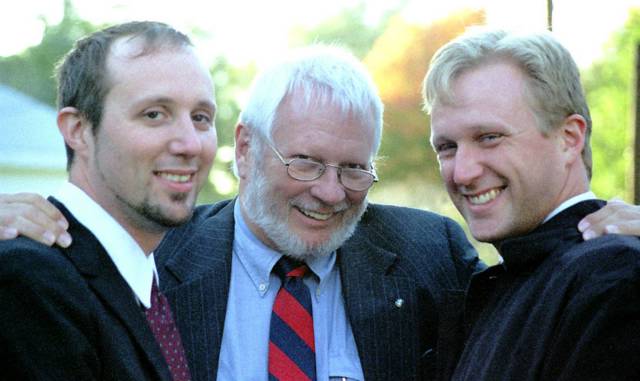
Me with my sons Sean (left) and Steve wearing Swiss Army overcoats I found in a military surplus catalog. Sean and I got lots of wear out of ours, but Steve didn't care for the style. Anyhow, here we are posing as the Swiss Army.
Saturday, August 07, 2004
How it is...
You can see it in their eyes.
You're sitting there at an intersection, waiting for the traffic signal to change when you notice the car next to you.
It's your average family car filled with your average dad and mom and the kids.
Maybe the kid are fussing at each other, but they're probably looking at you and your motorcycle.
Sometimes they smile and wave and other times they just stare. You look at their faces and see that look. It's a look that says if they could trade places with you - suddenly be transformed into licensed motorcycle operators with bikes just like yours - they'd give up their window seat in the back instantly and forever.
Then Dad turns and, if you look closely, you can see the same yearning in his face.
Maybe he's fed up with the yammering of the kids or maybe he's going somewhere he doesn't want to go.
Maybe he's got a motorcycle of his own in the garage at home and seeing you on your bike reminds him of how he'd rather be riding free instead of stuck in a stuffy steel box on four wheels.
But more likely, he's always wanted to ride but never had the time or the energy or the nerve to get into motorcycling. Never mind the reasons. All that matters at the moment is that he would change places with you just as quickly has his kids would.
The scene changes and you're riding along a residential street and suddenly you notice that your passage is a sort of minor neighborhood event.
Kids on bicycles watch admiringly as you ride by.
Their parents look up from their lawnmowers or sprinklers or other yardwork to take note of your passage.
It's an extraordinary car that gets that kind of attention just rolling down the street, but almost any motorcyclist can expect it, even if his bike is well-muffled and whisper-quiet.
And there and there you can see that look again. That look that reminds you you're doing something special. Something infinitely more fun than what anybody else is doing.
The scene changes again and you're riding down the interstate. Up ahead in the distance, through the shimmering waves of summer heat, you see the single headlight of another bike approaching.
Your eyes include the light in their scan of the scene ahead and details of a riding and motorcycle begin to materialize around it. You know that across the median and down the road the other rider is probably watching you and your bike take shape around the white fire of your headlight.
Just before you meet, you see the other rider's left hand come up in a friendly wave and, almost without thinking, you return the greeting.
So why did he wave and why did it seem so natural to wave back at this complete stranger? Chances are, if you knew the guy, you might not even like him.
You don't see car drivers waving at each other as they meet on the highway. If you met the other rider on a sidewalk or in an elevator, you wouldn't exchange greetings.
The reason for the wave and the admiring looks is the inescapable fact that, when you ride a motorcycle, every ride is an adventure, whether it's a transcontinental journey or a trip to the store for a loaf of bread.
Most non-riders sense it intuitively and it's practically an article of faith for those who ride.
Those who ride take a greater risk than those who don't.
But then, how many car drivers look forward to the drive to work and back or find themselves laughing out loud at the sheer joy of the road on a sunny day?
You're sitting there at an intersection, waiting for the traffic signal to change when you notice the car next to you.
It's your average family car filled with your average dad and mom and the kids.
Maybe the kid are fussing at each other, but they're probably looking at you and your motorcycle.
Sometimes they smile and wave and other times they just stare. You look at their faces and see that look. It's a look that says if they could trade places with you - suddenly be transformed into licensed motorcycle operators with bikes just like yours - they'd give up their window seat in the back instantly and forever.
Then Dad turns and, if you look closely, you can see the same yearning in his face.
Maybe he's fed up with the yammering of the kids or maybe he's going somewhere he doesn't want to go.
Maybe he's got a motorcycle of his own in the garage at home and seeing you on your bike reminds him of how he'd rather be riding free instead of stuck in a stuffy steel box on four wheels.
But more likely, he's always wanted to ride but never had the time or the energy or the nerve to get into motorcycling. Never mind the reasons. All that matters at the moment is that he would change places with you just as quickly has his kids would.
The scene changes and you're riding along a residential street and suddenly you notice that your passage is a sort of minor neighborhood event.
Kids on bicycles watch admiringly as you ride by.
Their parents look up from their lawnmowers or sprinklers or other yardwork to take note of your passage.
It's an extraordinary car that gets that kind of attention just rolling down the street, but almost any motorcyclist can expect it, even if his bike is well-muffled and whisper-quiet.
And there and there you can see that look again. That look that reminds you you're doing something special. Something infinitely more fun than what anybody else is doing.
The scene changes again and you're riding down the interstate. Up ahead in the distance, through the shimmering waves of summer heat, you see the single headlight of another bike approaching.
Your eyes include the light in their scan of the scene ahead and details of a riding and motorcycle begin to materialize around it. You know that across the median and down the road the other rider is probably watching you and your bike take shape around the white fire of your headlight.
Just before you meet, you see the other rider's left hand come up in a friendly wave and, almost without thinking, you return the greeting.
So why did he wave and why did it seem so natural to wave back at this complete stranger? Chances are, if you knew the guy, you might not even like him.
You don't see car drivers waving at each other as they meet on the highway. If you met the other rider on a sidewalk or in an elevator, you wouldn't exchange greetings.
The reason for the wave and the admiring looks is the inescapable fact that, when you ride a motorcycle, every ride is an adventure, whether it's a transcontinental journey or a trip to the store for a loaf of bread.
Most non-riders sense it intuitively and it's practically an article of faith for those who ride.
Those who ride take a greater risk than those who don't.
But then, how many car drivers look forward to the drive to work and back or find themselves laughing out loud at the sheer joy of the road on a sunny day?
Friday, August 06, 2004

Today is the 59th anniversary of the atomic bomb drop on Hiroshima. I had the honor of meeting Paul Tibbetts Jr., the pilot who flew that first-ever atomic bombing mission, a few years (and pounds) ago at a militaria show in Louisville, Ky. And, yes, I thanked him for what he did for his generation and mine and all successive generations of Americans. Despite what revisionist historians would have us believe, it was a necessary mission. Those who want to kill us today would do well to remember we are the only nation on earth to use atomic weapons and we did it twice. So far, in the war on terror, this has been us using precision munitions and being nice. They don’t ever want to see us in a blind rage.
Justice!!!
We were in court again this morning - this time for a hearing to garnish the pay of my former tenant who skipped out last year because I offered her a free washer and dryer (see earlier posts).
Just to bring you up to date (I know this is a matter of grave concern to everyone who stumbles in here), I won a $2,100-something judgment in May as compensation for lost income when she bailed out just six months into a 3½-year lease. A month went by and she made no effort to pay me or even contact me about a payment schedule.
So I exercised my right as a victorious plaintiff and filed to have her employer pay me directly from her earnings, taking her out of the decision-making loop. Under state law, I can take up to 25% of her pay.
Last month, after I requested garnishment, she sent us a $45 payment. We got another $45 from her in yesterday's mail.
In court this morning, she claimed $45 a month was all she could afford to pay. She said the HR person at her workplace told her garnishment could be as much as $290/month, which she claims would leave her with $50 to live on. How sad.
Paying us back at the rate of $45 a month would take nearly four years to cover just part of a loss that we incurred in three months.
After she made her statement, the judge turned to me and asked, "Do you wish to garnish her pay or do you want to make some other arrangement?"
A flicker of compassion flashed through my mind. Then I remembered I had offered her $250 to buy her own washer and dryer and that the judge deducted that same $250 from the settlement.
"I request garnishment," I said.
"Very well. So adjudged," he said, adding, "You're free to go."
Slam dunk. Pay up, Rita.
Just to bring you up to date (I know this is a matter of grave concern to everyone who stumbles in here), I won a $2,100-something judgment in May as compensation for lost income when she bailed out just six months into a 3½-year lease. A month went by and she made no effort to pay me or even contact me about a payment schedule.
So I exercised my right as a victorious plaintiff and filed to have her employer pay me directly from her earnings, taking her out of the decision-making loop. Under state law, I can take up to 25% of her pay.
Last month, after I requested garnishment, she sent us a $45 payment. We got another $45 from her in yesterday's mail.
In court this morning, she claimed $45 a month was all she could afford to pay. She said the HR person at her workplace told her garnishment could be as much as $290/month, which she claims would leave her with $50 to live on. How sad.
Paying us back at the rate of $45 a month would take nearly four years to cover just part of a loss that we incurred in three months.
After she made her statement, the judge turned to me and asked, "Do you wish to garnish her pay or do you want to make some other arrangement?"
A flicker of compassion flashed through my mind. Then I remembered I had offered her $250 to buy her own washer and dryer and that the judge deducted that same $250 from the settlement.
"I request garnishment," I said.
"Very well. So adjudged," he said, adding, "You're free to go."
Slam dunk. Pay up, Rita.
Friday, July 30, 2004
Movie Review: Gummo
Sometmes, when the mood strikes me, I volunteer a movie or book or product review to Amazon.com. Here's what I wrote about the film, Gummo:
Director Harmony Korine may or may not be the latest "enfant terrible," but he's certainly given us something to think about with "Gummo." He's given us about 90 minutes of in-your-face immersion into a culture that most of us only glimpse in "Cops" and other "reality" programs that deal with the hopeless, hapless people who make up the bottom strata of White America.
We suddenly find ourselves immersed in a culture where single moms huff glue with their teenage sons and their buddies and where boys hunt neighborhood cats with BB guns and sell the carcasses to a guy who supplies meat to Chinese restaurants.
As the story develops, we learn the boys spend their cat money on glue and the services of a young prostitute who looks like Anna Nicole Smith with a lobotomy.
This movie is like a train wreck - at once horrifying and mesmerizing.I disagree with an earlier reviewer who saw Gummo as an outrageous piece of elitism.
I think that charge misses the point. This is not some arrogant exposé of the quaint ways of the poor, it's a 90-minute tour of the self-perpetuating Culture of Stupidity that can be found on the fringes of every city and town in America. These are people who turn bad choices into a way of life because that's what their parents did and their parents before them. Yes, Korine packs the screen with enough geeks and freaks to populate a dozen circus sideshows, but his point is well taken. This is a strata of society that Hollywood ignores, except for the occasional cameo role in films like "Deliverance." It's a vision of a reality that we recognize instantly from our day-to-day experience, but which is carefully filtered out of the mass media.Whether Korine has talent or promise in any convential sense of the words remains to be seen, but he's created a unique film that is destined to become a cult classic.
But, as an earlier reviewer noted, this is not a suitable date night substitute for "Casablanca" or "The Sound of Music."
Director Harmony Korine may or may not be the latest "enfant terrible," but he's certainly given us something to think about with "Gummo." He's given us about 90 minutes of in-your-face immersion into a culture that most of us only glimpse in "Cops" and other "reality" programs that deal with the hopeless, hapless people who make up the bottom strata of White America.
We suddenly find ourselves immersed in a culture where single moms huff glue with their teenage sons and their buddies and where boys hunt neighborhood cats with BB guns and sell the carcasses to a guy who supplies meat to Chinese restaurants.
As the story develops, we learn the boys spend their cat money on glue and the services of a young prostitute who looks like Anna Nicole Smith with a lobotomy.
This movie is like a train wreck - at once horrifying and mesmerizing.I disagree with an earlier reviewer who saw Gummo as an outrageous piece of elitism.
I think that charge misses the point. This is not some arrogant exposé of the quaint ways of the poor, it's a 90-minute tour of the self-perpetuating Culture of Stupidity that can be found on the fringes of every city and town in America. These are people who turn bad choices into a way of life because that's what their parents did and their parents before them. Yes, Korine packs the screen with enough geeks and freaks to populate a dozen circus sideshows, but his point is well taken. This is a strata of society that Hollywood ignores, except for the occasional cameo role in films like "Deliverance." It's a vision of a reality that we recognize instantly from our day-to-day experience, but which is carefully filtered out of the mass media.Whether Korine has talent or promise in any convential sense of the words remains to be seen, but he's created a unique film that is destined to become a cult classic.
But, as an earlier reviewer noted, this is not a suitable date night substitute for "Casablanca" or "The Sound of Music."
Thursday, July 29, 2004


After 18 days on the road, including 3,836 motorcycle miles in the past seven days (6,079 for the entire trip), it feels kinda strange to be home.
It felt really weird to drive my car Monday. I found myself looking for the neutral light (motorcycle joke) before putting it into gear.
I just finished crunching the numbers and entering all of my receipts into my Quicken software and determined the trip wasn't as financially paralyzing as I had feared it would be.
At an average daily cost of $67.36, it cost me about 20¢ per mile. I spent about $400 on lodging, but that was considerably less than it might have been had I not had the generous hospitality of my friends in Alma. The cost of food and fuel was about even at around $350 each. The bike delivered an average of 38 miles/gallon with a high of 50.3 mpg on the downhill ride from Hartsel, Colo. to Colorado Springs and a low of 35.9 mpg on I-70 from Wakeeney, Kans. to Salina, Kans.
All things considered and not counting getting assaulted in California last Wednesday with a SUV, this was the easiest and most comfortable long haul ride I've done in the history of my 19 annual Mid-Life Crisis Tours. Most of the credit goes to the new BMW K1200GT. With its heated comfort seat, heated grips, electronic cruise control and electrically operated windscreen, it's a terrific bike for gobbling up huge chunks of highway, yet it's supremely nimble in mountain twisties. I've already jabbered on at length about the XM satellite radio, so suffice it to say it does a wonderful job of alleviating boredom, not to mention giving me useful realtime traffic/weather reports for St. Louis and San Francisco.
Even though I've been at this for more than 20 years, I learn new ways to improve my touring technique and kit every time I go out.
This time, the most prominent lessons are:
1. Never again take my monstrous 5-pound (well, 4 pounds 11.5 ounces with lens) Nikon F5 film camera on the bike. It's big and unwieldy and the film takes up way too much space, not to mention the fact that I'm deep enough into digital now that I hate paying for film, then having to pay again for processing. When it comes to motorcycle touring, I hope to have a large-megapixel digital point-and-shoot - like the Nikon CoolPix 5700 or somesuch - and an image tank for nearly limitless photo possibilities.
2. I finally see a point to a Palm Pilot. Before this trip, I thought they were just expensive overblown pocket notebooks. After examining, and almost buying, a Palm Pilot Zire 71 that the Dillon, Colo. OfficeMax was blowing out in favor of a newer model, I began to see how it could fit into my way of doing things. Unfortunately, the model I really need has WiFi capability and costs about $400. But give me one of those, a fold-out keyboard and a truck stop or Starbuck's or McDonald's with WiFi service and I can blog and journal and e-mail my brains out. As it turned out, I did practically no journaling on this trip because (a) it's a hassle to write longhand in my travel log and (b) I was with friends almost constantly and found it very inconvenient to block out time for writing.
Both of these technology upgrades would weigh less, take up less space and do much much more.
That's important, considering the reduced luggage capacity of the K1200GT, compared with my old '91 K100RS. BMW makes larger capacity lids for their saddlebags. That might be a good solution, but I'm worried about how goofy they would look on the bike, making for a considerably wider profile.
It felt really weird to drive my car Monday. I found myself looking for the neutral light (motorcycle joke) before putting it into gear.
I just finished crunching the numbers and entering all of my receipts into my Quicken software and determined the trip wasn't as financially paralyzing as I had feared it would be.
At an average daily cost of $67.36, it cost me about 20¢ per mile. I spent about $400 on lodging, but that was considerably less than it might have been had I not had the generous hospitality of my friends in Alma. The cost of food and fuel was about even at around $350 each. The bike delivered an average of 38 miles/gallon with a high of 50.3 mpg on the downhill ride from Hartsel, Colo. to Colorado Springs and a low of 35.9 mpg on I-70 from Wakeeney, Kans. to Salina, Kans.
All things considered and not counting getting assaulted in California last Wednesday with a SUV, this was the easiest and most comfortable long haul ride I've done in the history of my 19 annual Mid-Life Crisis Tours. Most of the credit goes to the new BMW K1200GT. With its heated comfort seat, heated grips, electronic cruise control and electrically operated windscreen, it's a terrific bike for gobbling up huge chunks of highway, yet it's supremely nimble in mountain twisties. I've already jabbered on at length about the XM satellite radio, so suffice it to say it does a wonderful job of alleviating boredom, not to mention giving me useful realtime traffic/weather reports for St. Louis and San Francisco.
Even though I've been at this for more than 20 years, I learn new ways to improve my touring technique and kit every time I go out.
This time, the most prominent lessons are:
1. Never again take my monstrous 5-pound (well, 4 pounds 11.5 ounces with lens) Nikon F5 film camera on the bike. It's big and unwieldy and the film takes up way too much space, not to mention the fact that I'm deep enough into digital now that I hate paying for film, then having to pay again for processing. When it comes to motorcycle touring, I hope to have a large-megapixel digital point-and-shoot - like the Nikon CoolPix 5700 or somesuch - and an image tank for nearly limitless photo possibilities.
2. I finally see a point to a Palm Pilot. Before this trip, I thought they were just expensive overblown pocket notebooks. After examining, and almost buying, a Palm Pilot Zire 71 that the Dillon, Colo. OfficeMax was blowing out in favor of a newer model, I began to see how it could fit into my way of doing things. Unfortunately, the model I really need has WiFi capability and costs about $400. But give me one of those, a fold-out keyboard and a truck stop or Starbuck's or McDonald's with WiFi service and I can blog and journal and e-mail my brains out. As it turned out, I did practically no journaling on this trip because (a) it's a hassle to write longhand in my travel log and (b) I was with friends almost constantly and found it very inconvenient to block out time for writing.
Both of these technology upgrades would weigh less, take up less space and do much much more.
That's important, considering the reduced luggage capacity of the K1200GT, compared with my old '91 K100RS. BMW makes larger capacity lids for their saddlebags. That might be a good solution, but I'm worried about how goofy they would look on the bike, making for a considerably wider profile.
Sunday, July 25, 2004
XM radio update
I just returned from about three weeks in the west with XM and have some observations.
I left the Wednesday after the Independence Day holiday and rode to the home of friends in Alma, Colo., just south of Breckenridge. I like to keep a journal of my travels and, when I sat down to write an account of my first day's ride - from Thorntown, IN to Topeka, KS - I realized I hadn't noticed all that much along the roadside. I found I reacted well to unexpected traffic movements, but the passing scenery didn't make all that much of an impression on me. That said, it was the most pleasant ride down I-70 through Missouri that I've ever experienced. Ditto the next day across Kansas.
I expected to lose the signal riding up into the mountains on U.S. 24 from Colorado Springs since the road passes through a deep canyon, but it never faltered. It was cool to ride for hours and hours listening to the same stations and never having them fade like terrestrial-based transmitters would.
There were occasions when the signal would blank out momentarily - like when a semitrailer truck would pass on my immediate south side, blocking the line of sight to the satellites, or going through the I-70 tunnels and gorge of Glenwood Canyon (I lost a couple of minutes of the long version of In-A-Gadda-Da-Vida on that one).
From Alma, I rode up to the BMW Motorcycle Owners of America national rally in Spokane. In the southern Idaho desert, I ran into a rainstorm that looked small enough that I could just blast through. It turned out to be deeper and heavier than I'd guessed and by the time I got pulled over and stowed the Roady, the buttons had stopped working. Fortunately, when I rode into the clear and re-mounted the Roady, the hot desert wind dried out whatever moisture was causing the problem and it functioned perfectly again.
The cord with the in-line volume control is a straight-in plug, unlike the ones on the power supply and the antenna, which are right-angle connections. Consequently, the output cord sticks out to the left of the unit. This became a major issue last Sunday when I was gassing to leave Spokane for Crater Lake and Big Sur.
I flipped up my Marsee tankbag to access the gas tank and inadvertently slammed it into the projecting output cord, ripping the Roady from its mount. The cords held it from crashing to the ground, but the impact severely loosened the output plug connection and it became increasingly unreliable over the next two days of riding.
Finally, the next day, it got to the point where I could no longer get a good output connection.
Distraught over being stuck in California without XM, I got on the phone in my Motel 6 room in Red Bluff, CA and called the XM 800 number to see if they could direct me to the nearest XM retailer. I figured I was going to end up with a second unit for my wife anyway, so why not get it now and use it for the rest of the trip?
They directed me to a T/A truck stop about 17 miles south down I-5. I phoned the truck stop and determined that they had a Roady and would hold it for me.
I rode there, bought the unit, used my cell phone to do the activation and had a fully activated and functional Roady working by the time I got back to the motel - all in the space of about an hour and 15 minutes. I can't say enough about how easy it is to get the unit activated once it's hooked up and ready to use.
Needless to say, I made a habit of unplugging the output cord before flipping up the tankbag at every gas stop for the rest of the trip. I think the ultimate fix will be to get a right-angle stereo miniplug adaptor for the output cord. I made a cursory search for a Radio Shack in Frisco, Colo. on the way home but was unsuccessful.
Once I have the right-angle adaptor in place, I should be able to use my rain cover - it doesn't fit properly with the current setup, causing me to have to stow the unit in my tankbag whenever it looks like rain. Sean Franklin of Cyclegadgets.com said the unit needs to breathe, so running it from inside a tankbag is not a good idea.
I left the Wednesday after the Independence Day holiday and rode to the home of friends in Alma, Colo., just south of Breckenridge. I like to keep a journal of my travels and, when I sat down to write an account of my first day's ride - from Thorntown, IN to Topeka, KS - I realized I hadn't noticed all that much along the roadside. I found I reacted well to unexpected traffic movements, but the passing scenery didn't make all that much of an impression on me. That said, it was the most pleasant ride down I-70 through Missouri that I've ever experienced. Ditto the next day across Kansas.
I expected to lose the signal riding up into the mountains on U.S. 24 from Colorado Springs since the road passes through a deep canyon, but it never faltered. It was cool to ride for hours and hours listening to the same stations and never having them fade like terrestrial-based transmitters would.
There were occasions when the signal would blank out momentarily - like when a semitrailer truck would pass on my immediate south side, blocking the line of sight to the satellites, or going through the I-70 tunnels and gorge of Glenwood Canyon (I lost a couple of minutes of the long version of In-A-Gadda-Da-Vida on that one).
From Alma, I rode up to the BMW Motorcycle Owners of America national rally in Spokane. In the southern Idaho desert, I ran into a rainstorm that looked small enough that I could just blast through. It turned out to be deeper and heavier than I'd guessed and by the time I got pulled over and stowed the Roady, the buttons had stopped working. Fortunately, when I rode into the clear and re-mounted the Roady, the hot desert wind dried out whatever moisture was causing the problem and it functioned perfectly again.
The cord with the in-line volume control is a straight-in plug, unlike the ones on the power supply and the antenna, which are right-angle connections. Consequently, the output cord sticks out to the left of the unit. This became a major issue last Sunday when I was gassing to leave Spokane for Crater Lake and Big Sur.
I flipped up my Marsee tankbag to access the gas tank and inadvertently slammed it into the projecting output cord, ripping the Roady from its mount. The cords held it from crashing to the ground, but the impact severely loosened the output plug connection and it became increasingly unreliable over the next two days of riding.
Finally, the next day, it got to the point where I could no longer get a good output connection.
Distraught over being stuck in California without XM, I got on the phone in my Motel 6 room in Red Bluff, CA and called the XM 800 number to see if they could direct me to the nearest XM retailer. I figured I was going to end up with a second unit for my wife anyway, so why not get it now and use it for the rest of the trip?
They directed me to a T/A truck stop about 17 miles south down I-5. I phoned the truck stop and determined that they had a Roady and would hold it for me.
I rode there, bought the unit, used my cell phone to do the activation and had a fully activated and functional Roady working by the time I got back to the motel - all in the space of about an hour and 15 minutes. I can't say enough about how easy it is to get the unit activated once it's hooked up and ready to use.
Needless to say, I made a habit of unplugging the output cord before flipping up the tankbag at every gas stop for the rest of the trip. I think the ultimate fix will be to get a right-angle stereo miniplug adaptor for the output cord. I made a cursory search for a Radio Shack in Frisco, Colo. on the way home but was unsuccessful.
Once I have the right-angle adaptor in place, I should be able to use my rain cover - it doesn't fit properly with the current setup, causing me to have to stow the unit in my tankbag whenever it looks like rain. Sean Franklin of Cyclegadgets.com said the unit needs to breathe, so running it from inside a tankbag is not a good idea.
Home again, home again...
I rolled into my driveway at 6:45 p.m. today, having covered about 700 miles since daybreak in Salina, Kans.
More later.
More later.
Saturday, July 24, 2004
Speed
I was flogging my BMW K1200GT across the desert on a highway that shall remain unnamed in a likewise unnamed state this week when a police officer coming from the other direction turned on his light bar, suggesting that he wished to have words with me.
Realizing he had me dead to rights, I pulled over and had my gloves and helmet off by the time he could turn around and park behind my bike.
"Do you know how fast you were going?" he asked with a friendly smile.
"Not really. I'd guess about 80," I replied, neglecting to mention I had my electronic cruise control set for 90 mph.
"Well, I had you at 91," he said.
I made a mental note about the accuracy of the cruise control.
In conversation it developed that he, too, is a motorcyclist and apparently has a sympathy for riders who like to go fast on an empty desert highway that is unrealistically posted at 65 mph.
So he wrote me up for a lesser speed, which didn't even constitute a moving violation and won't show up on my driving record or come to the attention of my insurance company.
Thank you, officer.
The fine is about $70 and, while I can think of lots of things I'd rather spend $70 on, it could have been much much worse.
Like, if he had seen me about an hour before when I was going 135 mph.
One of the things on my vacation "to-do" list was to see how fast my new bike will go - something I don't care to try in my midwestern home state with its high-traffic, short line-of-sight roads. Out here in the west, there are lots of empty desert highways that are a straight line to the horizon with nothing on either side of the road for miles,
I'm pretty sure the bike is capable of higher speeds, but the huge waterproof duffle-style bag strapped to the luggage rack is like a big air brake. If I'd taken the time to lash it to the seat along the axis of the bike frame, I'm confident I could have seen 150 mph.
Realizing he had me dead to rights, I pulled over and had my gloves and helmet off by the time he could turn around and park behind my bike.
"Do you know how fast you were going?" he asked with a friendly smile.
"Not really. I'd guess about 80," I replied, neglecting to mention I had my electronic cruise control set for 90 mph.
"Well, I had you at 91," he said.
I made a mental note about the accuracy of the cruise control.
In conversation it developed that he, too, is a motorcyclist and apparently has a sympathy for riders who like to go fast on an empty desert highway that is unrealistically posted at 65 mph.
So he wrote me up for a lesser speed, which didn't even constitute a moving violation and won't show up on my driving record or come to the attention of my insurance company.
Thank you, officer.
The fine is about $70 and, while I can think of lots of things I'd rather spend $70 on, it could have been much much worse.
Like, if he had seen me about an hour before when I was going 135 mph.
One of the things on my vacation "to-do" list was to see how fast my new bike will go - something I don't care to try in my midwestern home state with its high-traffic, short line-of-sight roads. Out here in the west, there are lots of empty desert highways that are a straight line to the horizon with nothing on either side of the road for miles,
I'm pretty sure the bike is capable of higher speeds, but the huge waterproof duffle-style bag strapped to the luggage rack is like a big air brake. If I'd taken the time to lash it to the seat along the axis of the bike frame, I'm confident I could have seen 150 mph.
Friday, July 23, 2004
Damned Rain
I'm back at Tim & Linda's place in Alma, Colo., studying the Weather Channel to see how much rain I'll have to contend with tomorrow when I continue eastward. Denver got flooded this afternoon - good thing I didn't act on that impulse to keep on going on I-70 when I got to the Frisco exit.
Unless the forecast calls for rain of Biblical proportions, I'll just have to deal with it because I'm intent on getting home Sunday.
But right now, it's 10:07 p.m. and I'm too tired to think about it.
G'night.
Unless the forecast calls for rain of Biblical proportions, I'll just have to deal with it because I'm intent on getting home Sunday.
But right now, it's 10:07 p.m. and I'm too tired to think about it.
G'night.
The Oracle Rear-ended by SUV
That oughta get your attention.
But, yes, it's true.
I left San Simeon, Calif., on Wednesday morning, heading for my son's place in Portland, Ore.
As is usually the case this time of year, there was heavy fog on the coast - they call it the marine layer out there - so I waited for some of it to burn off and finally got onto the road about 8 a.m. By the time I got 3 miles inland, I was in bright sunshine. I gassed at Paso Robles and picked up Highway 46 east (the road where James Dean bought the farm), then turned on to Highway 41 to link with I-5 for the run north to Oregon.
About 12 miles short of the "5," I came upon a road construction site, pulled up behind three other vehicles and shut off my engine. I watched as a big Ford Club Wagon SUV slowed and stopped behind me. We sat there in the hot California sun about 10 minutes and I entertained myself by setting some pre-set buttons on my XM satellite radio receiver.
Presently, a line of oncoming traffic came through and I noticed the CalTrans pilot truck turning around to lead my group of vehicles through the construction zone.
I started the engine and was about to put the bike in gear when the motorcycle lurched violently forward and to the left, causing the bike to fall over onto its left side and taking me with it.
My first thought was, "Shit! I accidentally tapped the gear shift lever and slammed it into first gear!"
But I knew I hadn't.
When I struggled to my feet, I saw the Ford Club Wagon's left front tire even with the rear wheel of my bike and the driver staring at me with a look of dull surprise.
"You stupid motherfucker! What the hell do you think you're doing?" I shouted, exercising remarkable restraint. "You're looking at about $6,000 worth of damage here, you fucking idiot!"
After all, we're talking about a $19,000 motorcycle slammed to the pavement by some fool who can't control his vehicle.
The driver, a guy in his early 50s named Mike from Lompoc, Calif., explained that he assaulted me with a two-ton SUV because he's handicapped and is using hand controls to drive.
"They're new and I'm not quite familiar with them," he offered.
I am not completely without compassion and I'm truly sorry that Mike has fucked up legs, but the fact remains that he has no business on a public highway if he cannot control his vehicle.
My wife narrowly escaped serious injury and her car was destroyed in March by a woman who was driving while blind (advanced macular degeneration). So I'm developing some strong opinions about sharing the road with people who should only be passengers.
The CalTrans flagger directed us to a spot just off the highway to sort things out and we exchanged insurance information. I determined there were deep gouges in the left saddlebag lid and the left fairing and my gear shift lever was bent to the point where I wondered if I could ride the bike.
I got out my BMW MOA Anonymous Book and determined the nearest dealer was in Fresno and decided to head for their shop.
As I pulled back onto the highway, I asked the flagger, "Please hold that sonofabitch back and don't let him out right behind me."
He grinned and gave me the thumbs-up signal.
Up at I-5, I stopped at a gas station and phoned my wife and BMW of Fresno. I got directions to the shop and was greeted with warmth and concern when I rode in.
The secretary took my helmet and jacket and stuck a diet cola in my hand while the service manager inspected my bike. He straightened the bent gear shift lever and also discovered that my right saddlebag was jammed forward, having apparently taken some of the force of the collision. It appeared that a portion of the mounting rail that the bag mount grips was broken away, so he gave me a tie-down strap to secure it, in case it tried to leave the bike at speed.
I decided to abort the ride to Portland and make for home, so as to handle the insurance claim, so I headed up Highway 99, focused on a Motel 6 room at Auburn, Calif., just northeast of Sacramento on I-80.
I got about a third of the way to Sacramento when I came upon a miles-long traffic jam caused by a flaming crash. Not willing to sit in the 96-degree heat, I exited the freeway and used dead reckoning to pick my way west over county and state highways to I-5.
I finally reached the motel about 8 p.m., completely fried from the day's events. All I wanted was to use the toilet, take a shower and fall into bed.
Given the way things had gone that day, it should have come as no surprise when I flushed the toilet and it backed up and overflowed onto the bathroom floor.
I phoned the front desk and reported the development, expecting assurance that (a) I would be given a new room or (b) a maintenance person was on the way to plunge the toilet and clean the floor.
"Come down to the desk and get the plunger," the desk clerk said.
"You expect me to plunge my own toilet?" I asked, incredulously.
"Well, I'm the only one here and I can't leave the desk," she replied.
So I got the fucking plunger and cleared the clog - which housekeeping should have detected when they made up the room after the previous occupant(s) left - and then got the mop and bucket and mopped up the water from the tile floor.
When I returned the mop and bucket, I told the clerk, "You know, I think I should get some consideration on my bill for this. This is hardly the advertised Motel 6 experience."
"Well, everyone just asks for the plunger..." she said, letting me know that there would be no bill adjustment.
"Okay, I'll take it up at the corporate level," I promised her and stalked off to take my badly needed shower.
And I still have a sore back and neck from getting whacked by Mike's SUV.
But, yes, it's true.
I left San Simeon, Calif., on Wednesday morning, heading for my son's place in Portland, Ore.
As is usually the case this time of year, there was heavy fog on the coast - they call it the marine layer out there - so I waited for some of it to burn off and finally got onto the road about 8 a.m. By the time I got 3 miles inland, I was in bright sunshine. I gassed at Paso Robles and picked up Highway 46 east (the road where James Dean bought the farm), then turned on to Highway 41 to link with I-5 for the run north to Oregon.
About 12 miles short of the "5," I came upon a road construction site, pulled up behind three other vehicles and shut off my engine. I watched as a big Ford Club Wagon SUV slowed and stopped behind me. We sat there in the hot California sun about 10 minutes and I entertained myself by setting some pre-set buttons on my XM satellite radio receiver.
Presently, a line of oncoming traffic came through and I noticed the CalTrans pilot truck turning around to lead my group of vehicles through the construction zone.
I started the engine and was about to put the bike in gear when the motorcycle lurched violently forward and to the left, causing the bike to fall over onto its left side and taking me with it.
My first thought was, "Shit! I accidentally tapped the gear shift lever and slammed it into first gear!"
But I knew I hadn't.
When I struggled to my feet, I saw the Ford Club Wagon's left front tire even with the rear wheel of my bike and the driver staring at me with a look of dull surprise.
"You stupid motherfucker! What the hell do you think you're doing?" I shouted, exercising remarkable restraint. "You're looking at about $6,000 worth of damage here, you fucking idiot!"
After all, we're talking about a $19,000 motorcycle slammed to the pavement by some fool who can't control his vehicle.
The driver, a guy in his early 50s named Mike from Lompoc, Calif., explained that he assaulted me with a two-ton SUV because he's handicapped and is using hand controls to drive.
"They're new and I'm not quite familiar with them," he offered.
I am not completely without compassion and I'm truly sorry that Mike has fucked up legs, but the fact remains that he has no business on a public highway if he cannot control his vehicle.
My wife narrowly escaped serious injury and her car was destroyed in March by a woman who was driving while blind (advanced macular degeneration). So I'm developing some strong opinions about sharing the road with people who should only be passengers.
The CalTrans flagger directed us to a spot just off the highway to sort things out and we exchanged insurance information. I determined there were deep gouges in the left saddlebag lid and the left fairing and my gear shift lever was bent to the point where I wondered if I could ride the bike.
I got out my BMW MOA Anonymous Book and determined the nearest dealer was in Fresno and decided to head for their shop.
As I pulled back onto the highway, I asked the flagger, "Please hold that sonofabitch back and don't let him out right behind me."
He grinned and gave me the thumbs-up signal.
Up at I-5, I stopped at a gas station and phoned my wife and BMW of Fresno. I got directions to the shop and was greeted with warmth and concern when I rode in.
The secretary took my helmet and jacket and stuck a diet cola in my hand while the service manager inspected my bike. He straightened the bent gear shift lever and also discovered that my right saddlebag was jammed forward, having apparently taken some of the force of the collision. It appeared that a portion of the mounting rail that the bag mount grips was broken away, so he gave me a tie-down strap to secure it, in case it tried to leave the bike at speed.
I decided to abort the ride to Portland and make for home, so as to handle the insurance claim, so I headed up Highway 99, focused on a Motel 6 room at Auburn, Calif., just northeast of Sacramento on I-80.
I got about a third of the way to Sacramento when I came upon a miles-long traffic jam caused by a flaming crash. Not willing to sit in the 96-degree heat, I exited the freeway and used dead reckoning to pick my way west over county and state highways to I-5.
I finally reached the motel about 8 p.m., completely fried from the day's events. All I wanted was to use the toilet, take a shower and fall into bed.
Given the way things had gone that day, it should have come as no surprise when I flushed the toilet and it backed up and overflowed onto the bathroom floor.
I phoned the front desk and reported the development, expecting assurance that (a) I would be given a new room or (b) a maintenance person was on the way to plunge the toilet and clean the floor.
"Come down to the desk and get the plunger," the desk clerk said.
"You expect me to plunge my own toilet?" I asked, incredulously.
"Well, I'm the only one here and I can't leave the desk," she replied.
So I got the fucking plunger and cleared the clog - which housekeeping should have detected when they made up the room after the previous occupant(s) left - and then got the mop and bucket and mopped up the water from the tile floor.
When I returned the mop and bucket, I told the clerk, "You know, I think I should get some consideration on my bill for this. This is hardly the advertised Motel 6 experience."
"Well, everyone just asks for the plunger..." she said, letting me know that there would be no bill adjustment.
"Okay, I'll take it up at the corporate level," I promised her and stalked off to take my badly needed shower.
And I still have a sore back and neck from getting whacked by Mike's SUV.
Saturday, July 17, 2004
Saturday at the 'MOA Rally
I had a nice conversation in the coffee line awhile ago with a guy from L.A. who is now going to explore the Lost Coast with his GS on the way home, thanks to information from me. I love being able to tell Californians new stuff about their home state.
It's amazing how much better I feel after the first shower in a couple of days. I was the second guy in the shower line this morning and the third guy in the breakfast line when my food vendor of choice opened his shutters.
While waiting for the Cyber Cafe to open, I cruised the vintage and show bike area.
My first two BWMs were represented - kind of. In lieu of my 1971 R50/5, I found an almost identical '72 model. It would have been inappropriate for me to swing a leg over the saddle, but I could still stand next to it and run my eyes over the speedo/tach display and gaze down at those massive finned cylinder heads jutting out on either side of the engine.
A veterinarian from suburban Portland, Ore., wheeled in a graphite gray '81 R100RS that is virtually identical to the one that changed my life in the summer of 1986. The saddlebags were newer than original and it had a Telefix fork brace that mine lacked, but it was pretty much like seeing my old Gray Ghost again - before the guy who bought it from me trashed it.
The vet said it had belonged to his late brother and was the only possession his brother had directly willed to anyone. So he was entering it into the bike show in his brother's memory.
I had a nice conversation with a guy from northern California who was polishing a gorgeously painted blue '88 K75S that I remember first seeing at the 'MOA national in Oshkosh, Wisc. back in the early 1990s. He's offering it for sale for $5k and I could imagine having a sufficiently weak moment to buy it, despite the 98,000 miles on the odometer.
It's amazing how much better I feel after the first shower in a couple of days. I was the second guy in the shower line this morning and the third guy in the breakfast line when my food vendor of choice opened his shutters.
While waiting for the Cyber Cafe to open, I cruised the vintage and show bike area.
My first two BWMs were represented - kind of. In lieu of my 1971 R50/5, I found an almost identical '72 model. It would have been inappropriate for me to swing a leg over the saddle, but I could still stand next to it and run my eyes over the speedo/tach display and gaze down at those massive finned cylinder heads jutting out on either side of the engine.
A veterinarian from suburban Portland, Ore., wheeled in a graphite gray '81 R100RS that is virtually identical to the one that changed my life in the summer of 1986. The saddlebags were newer than original and it had a Telefix fork brace that mine lacked, but it was pretty much like seeing my old Gray Ghost again - before the guy who bought it from me trashed it.
The vet said it had belonged to his late brother and was the only possession his brother had directly willed to anyone. So he was entering it into the bike show in his brother's memory.
I had a nice conversation with a guy from northern California who was polishing a gorgeously painted blue '88 K75S that I remember first seeing at the 'MOA national in Oshkosh, Wisc. back in the early 1990s. He's offering it for sale for $5k and I could imagine having a sufficiently weak moment to buy it, despite the 98,000 miles on the odometer.
Friday, July 16, 2004
Rally Report

I'm blogging from the cyber cafe at the BMW Motorcycle Owners of America International Rally in Spokane. There are about 5,000 of us at the rally, sweltering in the blazing sun with a high in the mid-90s expected today.
Those of us who chose to camp don't dare go anywhere near our tents as long as the sun is up because they become like a sauna on steroids.
I hooked up with my friend Wayne this morning and it looks like we're going to ride together post-rally to Crater Lake and Big Sur and then double back to Portland to visit my son.
The ride up was uneventful. I rode about 670 miles Wednesday from Alma to Twin Falls, Idaho. I skirted thunderstorms in eastern Utah and finally ran through a small, but intense, shower just north of the Utah-Idaho border that temporarily shorted out the controls of my Delphi Roady XM radio receiver. Fortunately, an hour of drying time in the hot arid desert air put things right and it was working perfectly by the time I got to the Twin Falls Motel 6.
I woke up a full hour ahead of my 5 a.m. wake-up call, had breakfast at the Twin Falls Flying J truckstop and got on the road as the sky was beginning to lighten. Thanks to the hour gain by crossing into the Pacific Time Zone, I was in southern Washington by noon and arrived at the fairgrounds in Spokane by 2 p.m. I didn't check my mileage, but I'd guess it was between 500 and 600 miles.
The campground is nearly full to the point where I'm afraid to move my bike for fear of coming back to find a tent in my parking space.
Tuesday, July 13, 2004
South Park: More than a cartoon
South Park, besides being a TV and movie cartoon, is a real place.
It's actually a geographic feature, rather than a Colorado town. There are three "parks" in the Colorado Rocky Mountains - North, Middle and South.
The "parks" are broad valleys - many miles across - bordered by mountain ranges that make up the Rocky Mountain chain.
South Park is a spectacular basin at 9,000 feet above sea level - an expanse of grass and ranches and horses and cattle and buffalo through which the South Platte River meanders.
Tim and I went for a 100-mile loop ride this afternoon, gassing up at Fairplay and heading northeast on U.S. 285, over Red Hill Pass and past Como to the little crossroads community of Jefferson. There, we turned east on Tarryall Road - a narrow blacktop track that winds alongside ranches and pastures populated by hundreds of horses and their foals. The road leaves the open range of South Park and plunges down small canyons cut by streams and adorned by outcroppings of granite. The posted speed limit for most of Tarryall Road is 40 mph, which is a very good idea considering it's riddled with potholes. The Park County Highway Department makes a game attempt to keep the holes patched, but it's a losing battle.
The road winds around what used to be the shoreline of Tarryall Reservoir. Once a popular recreational facility with boat ramps and picnic and toilet facilities, Tarryall Reservoir has been reduced to a pond by the ongoing drought and the greedy demands of Denver and other Front Range communities that gobbled up the high country water rights before people up here were numerous and alert enough to protest.
The road curves south and Ts into U.S. 24. From there, it's only a few miles up and over 9,500-foot Wilkerson Pass. We took a break at the Wilkerson Pass Visitor Center to admire the view of South Park and the 14,000-foot peaks that ring it. To the east, Pike's Peak stood out in sharp relief in the late afternoon sun.
As we descended into the park, we could see U.S. 24 stretching out like a silver ribbon the 10 miles to Hartsel.
Just west of Hartsel, we picked up Colo. 9, which took us back to Fairplay. We pulled in to the Shell station at the south end of town and I noticed my trip meter had registered exactly 100 miles since we gassed at a station just up the road.
I topped off my tank in anticipation of tomorrow morning's departure for Spokane.
As I write this entry at 8:20 p.m., my laundry is done, the bike is fueled and my course is charted.
I leave early tomorrow for Spokane, via Twin Falls, Idaho.
The plan is to take U.S. 40 to Ogden, Utah, where I pick up the interstate north to Idaho and Twin Falls. Thursday, it's up through the Palouse to Spokane and the BMW national rally.
Tim's trip planning software shows it would actually be shorter and faster to go back down to Denver and take the interstate north through Wyoming and Montana, coming into Spokane by way of Coeur d'Alene, Idaho. Maybe so, but my gut feeling is that I'll have less likelihood of rain and cold if I take the long way.
My friend Sean Franklin, who runs Cyclegadgets.com, will be among the rally vendors. He has set up an internet cafe at some previous rallies. If he does that in Spokane, I'll update the blog. Otherwise, I'll check in from Portland.
While I've thoroughly enjoyed Tim and Linda's hospitality, my mind is already on the road north and west. I'll be up by 5 and on the road by 6 in anticipation of what promises to be a 700-mile day.
It's actually a geographic feature, rather than a Colorado town. There are three "parks" in the Colorado Rocky Mountains - North, Middle and South.
The "parks" are broad valleys - many miles across - bordered by mountain ranges that make up the Rocky Mountain chain.
South Park is a spectacular basin at 9,000 feet above sea level - an expanse of grass and ranches and horses and cattle and buffalo through which the South Platte River meanders.
Tim and I went for a 100-mile loop ride this afternoon, gassing up at Fairplay and heading northeast on U.S. 285, over Red Hill Pass and past Como to the little crossroads community of Jefferson. There, we turned east on Tarryall Road - a narrow blacktop track that winds alongside ranches and pastures populated by hundreds of horses and their foals. The road leaves the open range of South Park and plunges down small canyons cut by streams and adorned by outcroppings of granite. The posted speed limit for most of Tarryall Road is 40 mph, which is a very good idea considering it's riddled with potholes. The Park County Highway Department makes a game attempt to keep the holes patched, but it's a losing battle.
The road winds around what used to be the shoreline of Tarryall Reservoir. Once a popular recreational facility with boat ramps and picnic and toilet facilities, Tarryall Reservoir has been reduced to a pond by the ongoing drought and the greedy demands of Denver and other Front Range communities that gobbled up the high country water rights before people up here were numerous and alert enough to protest.
The road curves south and Ts into U.S. 24. From there, it's only a few miles up and over 9,500-foot Wilkerson Pass. We took a break at the Wilkerson Pass Visitor Center to admire the view of South Park and the 14,000-foot peaks that ring it. To the east, Pike's Peak stood out in sharp relief in the late afternoon sun.
As we descended into the park, we could see U.S. 24 stretching out like a silver ribbon the 10 miles to Hartsel.
Just west of Hartsel, we picked up Colo. 9, which took us back to Fairplay. We pulled in to the Shell station at the south end of town and I noticed my trip meter had registered exactly 100 miles since we gassed at a station just up the road.
I topped off my tank in anticipation of tomorrow morning's departure for Spokane.
As I write this entry at 8:20 p.m., my laundry is done, the bike is fueled and my course is charted.
I leave early tomorrow for Spokane, via Twin Falls, Idaho.
The plan is to take U.S. 40 to Ogden, Utah, where I pick up the interstate north to Idaho and Twin Falls. Thursday, it's up through the Palouse to Spokane and the BMW national rally.
Tim's trip planning software shows it would actually be shorter and faster to go back down to Denver and take the interstate north through Wyoming and Montana, coming into Spokane by way of Coeur d'Alene, Idaho. Maybe so, but my gut feeling is that I'll have less likelihood of rain and cold if I take the long way.
My friend Sean Franklin, who runs Cyclegadgets.com, will be among the rally vendors. He has set up an internet cafe at some previous rallies. If he does that in Spokane, I'll update the blog. Otherwise, I'll check in from Portland.
While I've thoroughly enjoyed Tim and Linda's hospitality, my mind is already on the road north and west. I'll be up by 5 and on the road by 6 in anticipation of what promises to be a 700-mile day.
Monday, July 12, 2004
Happy Birthday to me
Wednesday is my birthday and, since I expect to be on the road to Spokane and without internet access, I'm writing about it today.
I will be 59 and, therefore, beginning the last year of my 50s before I hit (I shudder when I think of it) 60. Ack!
It seems like only last week when I was 18, getting ready to start the final year of my teens. I remember it with startling clarity. Of course, I can't tell you what I had for lunch last Tuesday.
All things considered, I wouldn't be eager to go back to being 18 or 19, or even 25. It would be like getting a lobotomy.
One of the things I never realized when I was younger was that, fallible though they are, most older people are wiser than their juniors.
I'm reminded of it in life discussions with my teenage stepson and stepdaughter and also with my two sons, who are 36 and 33.
I can tell when I talk with my stepson that he labors under the mistaken impression that he is my equal in terms of intellect, judgment, maturity and wisdom. Hah.
The great consolation prize for getting older is that (assuming you've been paying attention) all of this life experience adds up to something.
I can spot wishful thinking and self-delusion a mile away and can predict with remarkable accuracy the outcome of most of my sons' and stepkids' decisions. Of course, this doesn't make me infallible in my own choices, but I'm a whole lot clearer about what's driving those choices and what the consequences will be.
I know, for instance, that if I settle for something less than what I really want - be it a motorcycle, a camera, a ballpoint pen or a relationship - I will regret it immediately and often until I correct the situation and get what I wanted in the first place. And the interesting thing is that once I get the desire established in my mind, it isn't long before it manifests. Sometimes I think it's just a matter of giving myself permission to have the thing I want. And I seem to be getting better at that all the time.
Some people think you have to have a life plan. My stepdaughter spent most of the last two years agonizing over a career path and choosing the right college and grad school to pursue that path. She was terrified of making the "wrong choice." Having goals is a fine and necessary thing, but flexibility is more important.
I warned her that if she finds herself at 35 in a dead-end job that she hates, the person she has to blame for it is the 17-year-old girl who locked her into it based on a 17-year-old's understanding of life.
So, am I happy about being 59 this week? Yeah, I guess. In terms of personal power, knowledge and happiness, it's never been better.
Maharishi used to say, "The past is always a lesser state of development."
Looking at the previous 58 years of my life, it holds true.
I will be 59 and, therefore, beginning the last year of my 50s before I hit (I shudder when I think of it) 60. Ack!
It seems like only last week when I was 18, getting ready to start the final year of my teens. I remember it with startling clarity. Of course, I can't tell you what I had for lunch last Tuesday.
All things considered, I wouldn't be eager to go back to being 18 or 19, or even 25. It would be like getting a lobotomy.
One of the things I never realized when I was younger was that, fallible though they are, most older people are wiser than their juniors.
I'm reminded of it in life discussions with my teenage stepson and stepdaughter and also with my two sons, who are 36 and 33.
I can tell when I talk with my stepson that he labors under the mistaken impression that he is my equal in terms of intellect, judgment, maturity and wisdom. Hah.
The great consolation prize for getting older is that (assuming you've been paying attention) all of this life experience adds up to something.
I can spot wishful thinking and self-delusion a mile away and can predict with remarkable accuracy the outcome of most of my sons' and stepkids' decisions. Of course, this doesn't make me infallible in my own choices, but I'm a whole lot clearer about what's driving those choices and what the consequences will be.
I know, for instance, that if I settle for something less than what I really want - be it a motorcycle, a camera, a ballpoint pen or a relationship - I will regret it immediately and often until I correct the situation and get what I wanted in the first place. And the interesting thing is that once I get the desire established in my mind, it isn't long before it manifests. Sometimes I think it's just a matter of giving myself permission to have the thing I want. And I seem to be getting better at that all the time.
Some people think you have to have a life plan. My stepdaughter spent most of the last two years agonizing over a career path and choosing the right college and grad school to pursue that path. She was terrified of making the "wrong choice." Having goals is a fine and necessary thing, but flexibility is more important.
I warned her that if she finds herself at 35 in a dead-end job that she hates, the person she has to blame for it is the 17-year-old girl who locked her into it based on a 17-year-old's understanding of life.
So, am I happy about being 59 this week? Yeah, I guess. In terms of personal power, knowledge and happiness, it's never been better.
Maharishi used to say, "The past is always a lesser state of development."
Looking at the previous 58 years of my life, it holds true.
Sunday, July 11, 2004
Riding in paradise
My friends and I did a little 180-mile loop today.
We set out about 10 a.m. from their home above Alma, Colo., and headed down Colo. 9 to Fairplay where we gassed the bikes.
Tim and Linda have yellow BMW F650 GS bikes with big stainless steel Jesse saddlebags. Their bikes are perfectly suited to where they live and are equally at home on the Interstate and up a rocky fire road. My dark blue K1200GT is what BMW calls a luxury sport-touring motorcycle. It's more of a one-trick pony, designed to gobble up huge stretches of highway at Autobahn speeds with some twisties thrown in for added excitement.
Since I'm not equipped to tackle rugged mountain gravel and dirt roads, my friends took pity on me and we did an easy ride on pavement.
The gas station was full of Harleys and their riders, fuelling up for the putt back down to Denver after the annual Fairplay Ladies' Run. The event started out as a fund-raising outing for female motorcyclists, but has turned into a tiny preview of the Black Hills Motorcycle Classic at Sturgis, S.D.
We definitely looked out of place with our helmets, high-tech armored textile riding gear and European bikes. The fact that we use earplugs, even though the baffles are still in our mufflers, must be completely incomprehensible to these folks.
While we saw a few helmets, most of the H-D riders and passengers we saw apparently think looking cool is more important than surviving a crash - headbands and bandanas for head protection, lots of fringe and loud exhaust. (The first time I saw a "Loud Pipes Save Lives" sticker in Daytona I thought it was a joke. It's not. They actually believe it.)
Tanks filled, we rode south to Buena Vista where we picked up the road up Cottonwood Pass. The Cottonwood summit is more than 12,000 feet above sea level and the air is thin, clear and cold at the top. There are also a few patches of snow, slowly sublimating in the brilliant July sun.
Cottonwood Pass is a fun ride, with sweeping curves and a few hairpin switchbacks just to keep you alert. The road over the pass is only paved on the Buena Vista side, which means there isn't a lot of through-traffic and even on a sunny Sunday in July we had the road mostly to ourselves.
After admiring the view from the summit for a few minutes, we rode back down to Buena Vista where I led the way to a Subway restaurant at the edge of town.
One of the day's goals was to visit a Wal-Mart so Tim and Linda could stock up on a few kitchen items and I could buy them a copy of Kevin Costner's Open Range on DVD. It's one of my favorite westerns, partially because my younger son was best buds in high school with Abraham Benrubi, who has a supporting role in the film.
Oh, yeah. That gives me 2 degrees of separation from Kevin Costner and Robert Duvall. (See earlier post.)
Our choices were Salida, which meant going home the way we had come, or Frisco, which called for a ride up U.S. 24 through Leadville to I-70, thence east to Frisco and from there, south on Colo. 9 through Breckenridge to Alma and home.
Frisco won and we had a splendid ride north along the Arkansas River where I once panned for gold (with microscopic success) several summers ago.
We saw an unusually large number of BMW motorcycles on the ride, suggestive of a big turnout next week at the BMW Motorcycle Owners of America International Rally in Spokane, Wash. The West is usually full of BMWs in the days preceding an 'MOA rally out this way because a lot of us love a good excuse to leave our lush green eastern homes to go bashing around the mountains and deserts of the Great American West. I expect there will be about 5,000 of us at Spokane.
We set out about 10 a.m. from their home above Alma, Colo., and headed down Colo. 9 to Fairplay where we gassed the bikes.
Tim and Linda have yellow BMW F650 GS bikes with big stainless steel Jesse saddlebags. Their bikes are perfectly suited to where they live and are equally at home on the Interstate and up a rocky fire road. My dark blue K1200GT is what BMW calls a luxury sport-touring motorcycle. It's more of a one-trick pony, designed to gobble up huge stretches of highway at Autobahn speeds with some twisties thrown in for added excitement.
Since I'm not equipped to tackle rugged mountain gravel and dirt roads, my friends took pity on me and we did an easy ride on pavement.
The gas station was full of Harleys and their riders, fuelling up for the putt back down to Denver after the annual Fairplay Ladies' Run. The event started out as a fund-raising outing for female motorcyclists, but has turned into a tiny preview of the Black Hills Motorcycle Classic at Sturgis, S.D.
We definitely looked out of place with our helmets, high-tech armored textile riding gear and European bikes. The fact that we use earplugs, even though the baffles are still in our mufflers, must be completely incomprehensible to these folks.
While we saw a few helmets, most of the H-D riders and passengers we saw apparently think looking cool is more important than surviving a crash - headbands and bandanas for head protection, lots of fringe and loud exhaust. (The first time I saw a "Loud Pipes Save Lives" sticker in Daytona I thought it was a joke. It's not. They actually believe it.)
Tanks filled, we rode south to Buena Vista where we picked up the road up Cottonwood Pass. The Cottonwood summit is more than 12,000 feet above sea level and the air is thin, clear and cold at the top. There are also a few patches of snow, slowly sublimating in the brilliant July sun.
Cottonwood Pass is a fun ride, with sweeping curves and a few hairpin switchbacks just to keep you alert. The road over the pass is only paved on the Buena Vista side, which means there isn't a lot of through-traffic and even on a sunny Sunday in July we had the road mostly to ourselves.
After admiring the view from the summit for a few minutes, we rode back down to Buena Vista where I led the way to a Subway restaurant at the edge of town.
One of the day's goals was to visit a Wal-Mart so Tim and Linda could stock up on a few kitchen items and I could buy them a copy of Kevin Costner's Open Range on DVD. It's one of my favorite westerns, partially because my younger son was best buds in high school with Abraham Benrubi, who has a supporting role in the film.
Oh, yeah. That gives me 2 degrees of separation from Kevin Costner and Robert Duvall. (See earlier post.)
Our choices were Salida, which meant going home the way we had come, or Frisco, which called for a ride up U.S. 24 through Leadville to I-70, thence east to Frisco and from there, south on Colo. 9 through Breckenridge to Alma and home.
Frisco won and we had a splendid ride north along the Arkansas River where I once panned for gold (with microscopic success) several summers ago.
We saw an unusually large number of BMW motorcycles on the ride, suggestive of a big turnout next week at the BMW Motorcycle Owners of America International Rally in Spokane, Wash. The West is usually full of BMWs in the days preceding an 'MOA rally out this way because a lot of us love a good excuse to leave our lush green eastern homes to go bashing around the mountains and deserts of the Great American West. I expect there will be about 5,000 of us at Spokane.
Saturday, July 10, 2004
Nice place to visit...
Lurching up the Mosquito Pass road at 5 mph in a Jeep this morning, I flashed on how great it is to be back in the high country.
My hosts have only been here a couple of years, but have become super involved with the community. Linda has just published a history of the region and strings for an area newspaper. Tim is a volunteer fire fighter and does computer repair, web site design and desktop publishing.
And they love to go bashing around the rock-strewn dusty mountain roads.
So while Tim manned the fire station, Linda and I drove about 6 miles up Mosquito Pass so she could take photos of an abandoned mine to go with a diabolically complicated water rights story she's written.
It boggles my midwestern mind that so many people are willing to live up these remote, rugged 4WD-only roads, miles from the nearest store, gas station or restaurant. I don't mind solitude, but I don't think I'd want to work so hard for it.
When we were out here a couple of months ago, Maria and I explored a "subdivision" out in South Park. We found a couple of houses for sale that looked very comfortable and had absolutely breath-taking views. But, even in good weather, they're about an hour from the nearest commercial establishment over dirt roads.
I suppose I could look at it as a natural progression from my 30+ years in a major metropolitan area to my present home in a small town of 1,500 people.
But, then, I'd hate to become so habituated to the grandeur of this place that I'd stop being amazed by it.
My hosts have only been here a couple of years, but have become super involved with the community. Linda has just published a history of the region and strings for an area newspaper. Tim is a volunteer fire fighter and does computer repair, web site design and desktop publishing.
And they love to go bashing around the rock-strewn dusty mountain roads.
So while Tim manned the fire station, Linda and I drove about 6 miles up Mosquito Pass so she could take photos of an abandoned mine to go with a diabolically complicated water rights story she's written.
It boggles my midwestern mind that so many people are willing to live up these remote, rugged 4WD-only roads, miles from the nearest store, gas station or restaurant. I don't mind solitude, but I don't think I'd want to work so hard for it.
When we were out here a couple of months ago, Maria and I explored a "subdivision" out in South Park. We found a couple of houses for sale that looked very comfortable and had absolutely breath-taking views. But, even in good weather, they're about an hour from the nearest commercial establishment over dirt roads.
I suppose I could look at it as a natural progression from my 30+ years in a major metropolitan area to my present home in a small town of 1,500 people.
But, then, I'd hate to become so habituated to the grandeur of this place that I'd stop being amazed by it.
Friday, July 09, 2004
News Item
CHICAGO (AP) - Bill Cosby issued another scathing critique this week of some members of the black community, telling a room full of activists that black children are running around not knowing how to read or write and "going nowhere."
He also had harsh words for some struggling black men, telling them, "Stop beating up your women because you can't find a job."
Cosby made headlines in May when he upbraided some poor blacks for their grammar and accused them of squandering opportunities the civil rights movement gave them. He shot back Thursday against his critics, saying his detractors were trying in vain to hide the black community's "dirty laundry."
"Let me tell you something, your dirty laundry gets out of school at 2:30 every day, it's cursing and calling each other n--- as they're walking up and down the street," Cosby said during an appearance at the Rainbow/PUSH Coalition & Citizenship Education Fund's annual conference.
"They think they're hip," the entertainer said. "They can't read; they can't write. They're laughing and giggling, and they're going nowhere."
In what has become a recent crusade of his, the comedian-actor, best known for his role as Heathcliff Huxtable on "The Cosby Show" from 1984 to 1992, said black parents should take a more active role in helping curtail the soaring high school dropout rate and pregnancy rate among black teens.
In his remarks in May at a commemoration of the anniversary of the Brown v. Board of Education desegregation decision, Cosby denounced some blacks' grammar and said those who commit crimes and wind up behind bars "are not political prisoners."
"I can't even talk the way these people talk, "Why you ain't,' "Where you is?' . . . and I blamed the kid until I heard the mother talk," Cosby said then. "And then I heard the father talk . . . Everybody knows it's important to speak English except these knuckleheads. You can't be a doctor with that kind of crap coming out of your mouth."
Cosby elaborated Thursday on his previous comments in a talk interrupted several times by applause. He castigated some blacks, saying that they cannot simply blame whites for problems such as teen pregnancy and high school dropout rates.
Cosby also lamented that the racial slurs once used by those who lynched blacks are now a favorite expression of many black children. And he blamed parents.
"When you put on a record and that record is yelling "n--- this and n--- that' and you've got your little 6-year-old, 7-year-old sitting in the back seat of the car, those children hear that," he said.
He also condemned black men who missed out on opportunities and are now angry about their lives.
"You've got to stop beating up your women because you can't find a job, because you didn't want to get an education and now you're (earning) minimum wage," Cosby said. "You should have thought more of yourself when you were in high school, when you had an opportunity."
Cosby appeared Thursday with the Rev. Jesse Jackson, founder and president of the education fund, who defended the entertainer's statements.
"Bill is saying let's fight the right fight, let's level the playing field," Jackson said. "Drunk people can't do that. Illiterate people can't do that."
He also had harsh words for some struggling black men, telling them, "Stop beating up your women because you can't find a job."
Cosby made headlines in May when he upbraided some poor blacks for their grammar and accused them of squandering opportunities the civil rights movement gave them. He shot back Thursday against his critics, saying his detractors were trying in vain to hide the black community's "dirty laundry."
"Let me tell you something, your dirty laundry gets out of school at 2:30 every day, it's cursing and calling each other n--- as they're walking up and down the street," Cosby said during an appearance at the Rainbow/PUSH Coalition & Citizenship Education Fund's annual conference.
"They think they're hip," the entertainer said. "They can't read; they can't write. They're laughing and giggling, and they're going nowhere."
In what has become a recent crusade of his, the comedian-actor, best known for his role as Heathcliff Huxtable on "The Cosby Show" from 1984 to 1992, said black parents should take a more active role in helping curtail the soaring high school dropout rate and pregnancy rate among black teens.
In his remarks in May at a commemoration of the anniversary of the Brown v. Board of Education desegregation decision, Cosby denounced some blacks' grammar and said those who commit crimes and wind up behind bars "are not political prisoners."
"I can't even talk the way these people talk, "Why you ain't,' "Where you is?' . . . and I blamed the kid until I heard the mother talk," Cosby said then. "And then I heard the father talk . . . Everybody knows it's important to speak English except these knuckleheads. You can't be a doctor with that kind of crap coming out of your mouth."
Cosby elaborated Thursday on his previous comments in a talk interrupted several times by applause. He castigated some blacks, saying that they cannot simply blame whites for problems such as teen pregnancy and high school dropout rates.
Cosby also lamented that the racial slurs once used by those who lynched blacks are now a favorite expression of many black children. And he blamed parents.
"When you put on a record and that record is yelling "n--- this and n--- that' and you've got your little 6-year-old, 7-year-old sitting in the back seat of the car, those children hear that," he said.
He also condemned black men who missed out on opportunities and are now angry about their lives.
"You've got to stop beating up your women because you can't find a job, because you didn't want to get an education and now you're (earning) minimum wage," Cosby said. "You should have thought more of yourself when you were in high school, when you had an opportunity."
Cosby appeared Thursday with the Rev. Jesse Jackson, founder and president of the education fund, who defended the entertainer's statements.
"Bill is saying let's fight the right fight, let's level the playing field," Jackson said. "Drunk people can't do that. Illiterate people can't do that."
Rocky Mountain high
It's a typically gorgeous July morning here in Alma, Colo. The temperature is in the high 50s and the sun is blazing down from a cloudless sky casting deep shadows in the pine forest that surrounds my friends' chalet. The ground squirrels are greedily gobbling up the seeds Tim & Linda have put out on the deck. They think it's a squirrel feeder, but it's actually a fox and bear feeder since the squirrels eventually get too fat and too slow to elude predators. There's a lesson in there somewhere.
I had a pleasant 1,300-mile ride Wednesday and Thursday, stopping overnight Wednesday in Topeka, Kans., for dinner with writer/photographer friends. My decision to leave a day later than planned worked out nicely. I got sprinkled on for about a quarter of a mile west of Topeka yesterday morning, with lightning strikes to the right and the left. (My wife said the storm showed up as a very angry-looking red blotch astride I-70 on the Weather Channel radar.)
Other than that, the only weather complaint would be the 90+ degree temperatures yesterday afternoon in eastern Colorado.
The XM satellite radio made Missouri, Kansas and eastern Colorado a pleasure. While I'm sufficiently connected with the riding experience to be a safe rider, I don't think the passing scenery registers as strongly on my awareness. When I opened my journal after breakfast yesterday at the Junction City, Kans. Cracker Barrel, I realized I didn't have very many observations about the previous day's ride to record other than fuel and food stops and the weather.
Now that I'm amid scenery that deserves to be savored, I plan to stow the XM and drink it all in.
The bike performed flawlessly and I rode mostly with restraint, only hitting 110 mph a couple of times while passing other traffic.
While most folks would take I-70 all the way across eastern Colorado to Denver and up into the mountains, my preferred route is to break away from I-70 at Oakley, Kans., picking up U.S. 40 into Colorado, where I turn onto Colo. 94 a few miles west of Kit Carson for a straight run into Colorado Springs. It involves a stretch of about 80 miles where there are no services. Maria and I call it Lonesome Cow Road because that's where we once saw a cow standing in the ditch, outside the fence, looking perplexed and bewildered at finding herself separated from the herd and suddenly free.
I find the short dose of surface street traffic in Colorado Springs preferable to the interstate blast through Denver.
Dinner last night was a bleu cheese and pepperjack hamburger with three glasses of excellent and very murky porter at the South Park Saloon (Tim was driving) - a nice way to celebrate my return to the high country.
I'm carrying my Nikon F5 film camera with the 28-300mm lens and an SB-50DX flash, along with 10 rolls of film. I think I mentioned earlier that I opted for film because I didn't want to subject my D100 to the dust and vibration of a motorcycle trip. But the constraints and sheer bulk of the film camera are making me long for a good digital point-and-shoot for travel work - something like the better Nikon CoolPix cameras. Just what I need - one more thing to spend money on.
I had a pleasant 1,300-mile ride Wednesday and Thursday, stopping overnight Wednesday in Topeka, Kans., for dinner with writer/photographer friends. My decision to leave a day later than planned worked out nicely. I got sprinkled on for about a quarter of a mile west of Topeka yesterday morning, with lightning strikes to the right and the left. (My wife said the storm showed up as a very angry-looking red blotch astride I-70 on the Weather Channel radar.)
Other than that, the only weather complaint would be the 90+ degree temperatures yesterday afternoon in eastern Colorado.
The XM satellite radio made Missouri, Kansas and eastern Colorado a pleasure. While I'm sufficiently connected with the riding experience to be a safe rider, I don't think the passing scenery registers as strongly on my awareness. When I opened my journal after breakfast yesterday at the Junction City, Kans. Cracker Barrel, I realized I didn't have very many observations about the previous day's ride to record other than fuel and food stops and the weather.
Now that I'm amid scenery that deserves to be savored, I plan to stow the XM and drink it all in.
The bike performed flawlessly and I rode mostly with restraint, only hitting 110 mph a couple of times while passing other traffic.
While most folks would take I-70 all the way across eastern Colorado to Denver and up into the mountains, my preferred route is to break away from I-70 at Oakley, Kans., picking up U.S. 40 into Colorado, where I turn onto Colo. 94 a few miles west of Kit Carson for a straight run into Colorado Springs. It involves a stretch of about 80 miles where there are no services. Maria and I call it Lonesome Cow Road because that's where we once saw a cow standing in the ditch, outside the fence, looking perplexed and bewildered at finding herself separated from the herd and suddenly free.
I find the short dose of surface street traffic in Colorado Springs preferable to the interstate blast through Denver.
Dinner last night was a bleu cheese and pepperjack hamburger with three glasses of excellent and very murky porter at the South Park Saloon (Tim was driving) - a nice way to celebrate my return to the high country.
I'm carrying my Nikon F5 film camera with the 28-300mm lens and an SB-50DX flash, along with 10 rolls of film. I think I mentioned earlier that I opted for film because I didn't want to subject my D100 to the dust and vibration of a motorcycle trip. But the constraints and sheer bulk of the film camera are making me long for a good digital point-and-shoot for travel work - something like the better Nikon CoolPix cameras. Just what I need - one more thing to spend money on.
If you drink...
I just re-read my previous post and was a little startled. I guess the lesson here is:
If you drink, don't blog
If you blog, don't drink
Honest, folks, I'm not really on a campaign to offend everyone. I just get overly blunt sometimes.
If you drink, don't blog
If you blog, don't drink
Honest, folks, I'm not really on a campaign to offend everyone. I just get overly blunt sometimes.
Tuesday, July 06, 2004
Well, maybe one last post...
I'm semi-hosed on rum and Diet Coke.
Rum and Coke was my dorm drink of choice when I was in college. I'd keep a pint of Bacardi in my desk drawer and add it to Coke from the vending machine on my dorm floor.
I got away from it for several years, living in the world of beer and Scotch and Margaritas.
But recently, I've gotten back to my roots, so to speak, and find a splash of Bacardi in a Diet Coke hits the spot.
But that's not what's on my mind - just what's in my mind.
My stepdaughter the college student has a summer job at the local library. This is one of those little smalltown Carnegie libraries that is just now - nearly 100 years downstream - undergoing an expansion and modernization.
One of the downsides of having a stepdaughter working in the local library is that you learn what kind of idiots are running the place.
The director is a longtime acquaintance. She was director of curriculum at one of the premiere school districts in the state and is not part of the scene I'm about to describe.
Most of the other women who work there are fundamentalist Christian types, which is fine, except that they let their religious perspective guide what materials are included in the library's collection. They also proselytize the kids who come into the children's department for summer reading programs.
Chances are that their religious bent actually reflects the majority beliefs of the community, but the First Amendment zealot in me recoils at the idea that they think they have the right to eliminate certain religious or philosophical or moral points of view from the public library that is supported by my tax dollars.
The stepdaughter reports hearing them worrying out loud about what is the "Christian" thing to do and also admonishing youngsters about what books they should or should not be reading.
Makes me wonder if they don't keep lists of what everyone is reading.
Keep in mind that I was raised a Presbyterian, but converted to Roman Catholicism as an adult. Which is to say I became Catholic as an informed decision rather than by the accident of birth.
The Catholic Church is a tough club to belong to because of the rules, but they also cut you an enormous amount of slack and don't cluck disapprovingly when you screw up.
The longer I am a Catholic (the original form of Christianity) the more I tend to regard Protestant denominations - not to mention Islam - as nutball made-up religions. Mostly silly exercises in mood-making and, in some instances, a form of mental illness.
How's that for a king-hell alcohol-amplified bias?
Rum and Coke was my dorm drink of choice when I was in college. I'd keep a pint of Bacardi in my desk drawer and add it to Coke from the vending machine on my dorm floor.
I got away from it for several years, living in the world of beer and Scotch and Margaritas.
But recently, I've gotten back to my roots, so to speak, and find a splash of Bacardi in a Diet Coke hits the spot.
But that's not what's on my mind - just what's in my mind.
My stepdaughter the college student has a summer job at the local library. This is one of those little smalltown Carnegie libraries that is just now - nearly 100 years downstream - undergoing an expansion and modernization.
One of the downsides of having a stepdaughter working in the local library is that you learn what kind of idiots are running the place.
The director is a longtime acquaintance. She was director of curriculum at one of the premiere school districts in the state and is not part of the scene I'm about to describe.
Most of the other women who work there are fundamentalist Christian types, which is fine, except that they let their religious perspective guide what materials are included in the library's collection. They also proselytize the kids who come into the children's department for summer reading programs.
Chances are that their religious bent actually reflects the majority beliefs of the community, but the First Amendment zealot in me recoils at the idea that they think they have the right to eliminate certain religious or philosophical or moral points of view from the public library that is supported by my tax dollars.
The stepdaughter reports hearing them worrying out loud about what is the "Christian" thing to do and also admonishing youngsters about what books they should or should not be reading.
Makes me wonder if they don't keep lists of what everyone is reading.
Keep in mind that I was raised a Presbyterian, but converted to Roman Catholicism as an adult. Which is to say I became Catholic as an informed decision rather than by the accident of birth.
The Catholic Church is a tough club to belong to because of the rules, but they also cut you an enormous amount of slack and don't cluck disapprovingly when you screw up.
The longer I am a Catholic (the original form of Christianity) the more I tend to regard Protestant denominations - not to mention Islam - as nutball made-up religions. Mostly silly exercises in mood-making and, in some instances, a form of mental illness.
How's that for a king-hell alcohol-amplified bias?
T minus 12 hours and counting...
Okay, I just studied the weather radars for the last couple of hours and concluded I probably could have shot down I-70 with only a couple of hours of rain between here and Topeka, Kans.
But in the interim I did a few last-minute things, including get a haircut, that I needed to take care of. I discovered last night that a small plastic spray bottle of Deep Woods Off froze and ruptured inside a little cordura pouch that velcros to the side of my right saddlebag. That's what I get for storing it in an unheated attic over the winter. The bug repellent turned the inner lining of the pouch into a gooey, unusable mess. Fortunately, I was able to call the bag maker's shop in California, determine that they would have a booth at the national BMW rally in Spokane weekend after next and that they would bring an extra pouch for me. It seems like a trivial thing, but I need all the carrying capacity I can get on that bike.
And, yes, I packed my journal so I can blog any profound thoughts and observations that may come to me during my travels.
As I write this, my eyes are watering from an overdose of Burberry cologne. My wife bought me a bottle over the weekend, hoping to lure me away from the aging bottle of KL Homme I still cling to. I applied just three spritzes from the spray bottle after my morning shower and I've been regretting it ever since. I don't know if it's because it's new and fresh or if it is just naturally more potent, but a little goes a loooooooooonnnng way. Now, nearly 12 hours later, my eyes are still watering and I get a noseful of cloyingly sweet citrus smell with every breath I take. From now on, one spritz will be enough. I'm surprised the young woman who cut my hair this afternoon could stand me.
The bike is gassed and loaded, except for the tankbag and the XM radio, which I'll attach just before I roll out in the morning.
This is the point at which I often ask myself why I'm doing this - going to the effort and expense of careening around the countryside on a motorcycle, all the way to the Pacific Ocean and back. I find myself wondering if I'll survive this trip, if I'll become someone else's roadkill or bugsplat. Will I ever see this place or my wife or my dog again?
Yeah, I know that sounds stupidly dramatic and the sheer act of writing the words gives more weight to the thoughts than they merit. But I have similar thoughts whenever I swing a leg over the saddle of my BMW. I think everyone who rides should start every ride with the realization that this is an activity that is inherently dangerous and risky and requires more skill and attention than droning down the Interstate on four wheels.
That realization is what helps keep me sharp and paying attention.
Unless something really significant pops into my mind during the night, this will be my last blog entry from home.
I'll have computer access in Colorado, maybe in Spokane and probably in Portland, so there will be updates as I travel.
Adios, Amigos.
But in the interim I did a few last-minute things, including get a haircut, that I needed to take care of. I discovered last night that a small plastic spray bottle of Deep Woods Off froze and ruptured inside a little cordura pouch that velcros to the side of my right saddlebag. That's what I get for storing it in an unheated attic over the winter. The bug repellent turned the inner lining of the pouch into a gooey, unusable mess. Fortunately, I was able to call the bag maker's shop in California, determine that they would have a booth at the national BMW rally in Spokane weekend after next and that they would bring an extra pouch for me. It seems like a trivial thing, but I need all the carrying capacity I can get on that bike.
And, yes, I packed my journal so I can blog any profound thoughts and observations that may come to me during my travels.
As I write this, my eyes are watering from an overdose of Burberry cologne. My wife bought me a bottle over the weekend, hoping to lure me away from the aging bottle of KL Homme I still cling to. I applied just three spritzes from the spray bottle after my morning shower and I've been regretting it ever since. I don't know if it's because it's new and fresh or if it is just naturally more potent, but a little goes a loooooooooonnnng way. Now, nearly 12 hours later, my eyes are still watering and I get a noseful of cloyingly sweet citrus smell with every breath I take. From now on, one spritz will be enough. I'm surprised the young woman who cut my hair this afternoon could stand me.
The bike is gassed and loaded, except for the tankbag and the XM radio, which I'll attach just before I roll out in the morning.
This is the point at which I often ask myself why I'm doing this - going to the effort and expense of careening around the countryside on a motorcycle, all the way to the Pacific Ocean and back. I find myself wondering if I'll survive this trip, if I'll become someone else's roadkill or bugsplat. Will I ever see this place or my wife or my dog again?
Yeah, I know that sounds stupidly dramatic and the sheer act of writing the words gives more weight to the thoughts than they merit. But I have similar thoughts whenever I swing a leg over the saddle of my BMW. I think everyone who rides should start every ride with the realization that this is an activity that is inherently dangerous and risky and requires more skill and attention than droning down the Interstate on four wheels.
That realization is what helps keep me sharp and paying attention.
Unless something really significant pops into my mind during the night, this will be my last blog entry from home.
I'll have computer access in Colorado, maybe in Spokane and probably in Portland, so there will be updates as I travel.
Adios, Amigos.
The Road Worrier
I'm sitting here, gazing out my home office window at sunshine.
Sunshine.
I got up at 5 a.m. to check the weather and found rain and thunderstorms - some severe - arrayed neatly along almost all of the portion of I-70 I had planned to ride today. In particular, Topeka (my destination for this evening) and Kansas City were getting hammered. Big time. One of my Topeka friends responded to my e-mail that I was postponing my departure by 24 hours with: "I think it was a wise decision. They said 6-8" limbs down from the heavy winds."
I've been waiting all morning for the rain to start here, but all we have is sunshine.
I just checked the weather radar (12:50 p.m.) and find that this morning's evil weather has pretty much evaporated.
Frustrating? Yes.
Do I think I made the right decision? Yes.
Do I think the storms will fire up again later today? Yes.
The forecast for I-70 tomorrow is sunny skies and moderate temperatures, which beats the hell out of starting a vacation with a long day in the rain.
Sunshine.
I got up at 5 a.m. to check the weather and found rain and thunderstorms - some severe - arrayed neatly along almost all of the portion of I-70 I had planned to ride today. In particular, Topeka (my destination for this evening) and Kansas City were getting hammered. Big time. One of my Topeka friends responded to my e-mail that I was postponing my departure by 24 hours with: "I think it was a wise decision. They said 6-8" limbs down from the heavy winds."
I've been waiting all morning for the rain to start here, but all we have is sunshine.
I just checked the weather radar (12:50 p.m.) and find that this morning's evil weather has pretty much evaporated.
Frustrating? Yes.
Do I think I made the right decision? Yes.
Do I think the storms will fire up again later today? Yes.
The forecast for I-70 tomorrow is sunny skies and moderate temperatures, which beats the hell out of starting a vacation with a long day in the rain.
Monday, July 05, 2004
Packing
I've been pulling my gear together and alternately cursing because I can't find something and rejoicing when something returns from having gone walkabout.
This is the first long (more than a week on the road) tour I've contemplated since I got my '03 BMW K1200GT in February of 2003.
In terms of speed and handling and creature comfort, it's a quantum jump from my '91 K100RS which I retired a couple of years ago after putting more than 160,000 miles on the odometer.
But for some reason known only to David Robb, chief designer for BMW motorcycles in Munich, it's a substantial step backward in terms of carrying capacity. Yes, it has hard saddlebags - color matched to the bike, even. But they're smaller than the ones on my old bike. The left one is especially small, since Herr Robb decided the K1200RS (the bike from which the GT is derived) should have an upswept exhaust pipe that needs a cutout on the inside of the bag.
I've packed my removable fabric saddlebag liners accordingly, but have yet to see if they'll fit into the actual saddlebags.
Motorcycle touring, for me anyway, necessitates a constant search for smaller stuff. I bought a smaller tent over the weekend because the one I've used for the past five years takes up too much space in the big waterproof bag that rides on the tail luggage rack and also holds my sleeping bag and Thermarest air mattress.
I've entertained myself on long boring stretches of highway (i.e. I-70 through Missouri, Kansas and eastern Colorado) with music from a Sony MiniDisc player loaded with hours of MP3s. I use custom fitted in-ear stereo monitors, made for me by an audiologist, so I get the benefit of glorious stereo sound as well as a huge reduction in wind noise and the attendant fatigue.
Last week, my wife gave me an early birthday present in the form of an XM satellite radio receiver. It mounts on a special bracket atop the brake fluid reservoir on the right side of the handlebars, freeing up a whole bunch of space in my tankbag and giving me a chance to hear hours and hours of new music rather than being limited to my own music collection. It also has the Weather Channel, news, and traffic/weather reports for several major cities.
So upgrades over my old bike now include:
Of course this all assumes no problems and reasonable weather. At the moment, the Weather Channel's website forecasts rain at every major city along I-70 from here to Topeka tomorrow. I have no desire to start my vacation with a day-long slog down the interstate in the rain, so if that wretched forecast is still in place tomorrow morning, I'll call my friends and put off my departure for 24 hours.
In the meantime, I keep thinking of stuff I forgot to pack and wonder how in hell I'm going to squeeze it all in.
This is the first long (more than a week on the road) tour I've contemplated since I got my '03 BMW K1200GT in February of 2003.
In terms of speed and handling and creature comfort, it's a quantum jump from my '91 K100RS which I retired a couple of years ago after putting more than 160,000 miles on the odometer.
But for some reason known only to David Robb, chief designer for BMW motorcycles in Munich, it's a substantial step backward in terms of carrying capacity. Yes, it has hard saddlebags - color matched to the bike, even. But they're smaller than the ones on my old bike. The left one is especially small, since Herr Robb decided the K1200RS (the bike from which the GT is derived) should have an upswept exhaust pipe that needs a cutout on the inside of the bag.
I've packed my removable fabric saddlebag liners accordingly, but have yet to see if they'll fit into the actual saddlebags.
Motorcycle touring, for me anyway, necessitates a constant search for smaller stuff. I bought a smaller tent over the weekend because the one I've used for the past five years takes up too much space in the big waterproof bag that rides on the tail luggage rack and also holds my sleeping bag and Thermarest air mattress.
I've entertained myself on long boring stretches of highway (i.e. I-70 through Missouri, Kansas and eastern Colorado) with music from a Sony MiniDisc player loaded with hours of MP3s. I use custom fitted in-ear stereo monitors, made for me by an audiologist, so I get the benefit of glorious stereo sound as well as a huge reduction in wind noise and the attendant fatigue.
Last week, my wife gave me an early birthday present in the form of an XM satellite radio receiver. It mounts on a special bracket atop the brake fluid reservoir on the right side of the handlebars, freeing up a whole bunch of space in my tankbag and giving me a chance to hear hours and hours of new music rather than being limited to my own music collection. It also has the Weather Channel, news, and traffic/weather reports for several major cities.
So upgrades over my old bike now include:
XM radioThe plan is to roll out early tomorrow morning and aim for Topeka, Kans. where I'll meet friends for dinner. Then, on Wednesday, it's off to Colorado. I hope to reach my destination at friends' house near Breckenridge sometime late Wednesday afternoon.
Electronic cruise control
Heated seat
Heated handgrips
Electrically adjustable windscreen
Of course this all assumes no problems and reasonable weather. At the moment, the Weather Channel's website forecasts rain at every major city along I-70 from here to Topeka tomorrow. I have no desire to start my vacation with a day-long slog down the interstate in the rain, so if that wretched forecast is still in place tomorrow morning, I'll call my friends and put off my departure for 24 hours.
In the meantime, I keep thinking of stuff I forgot to pack and wonder how in hell I'm going to squeeze it all in.
Friday, July 02, 2004
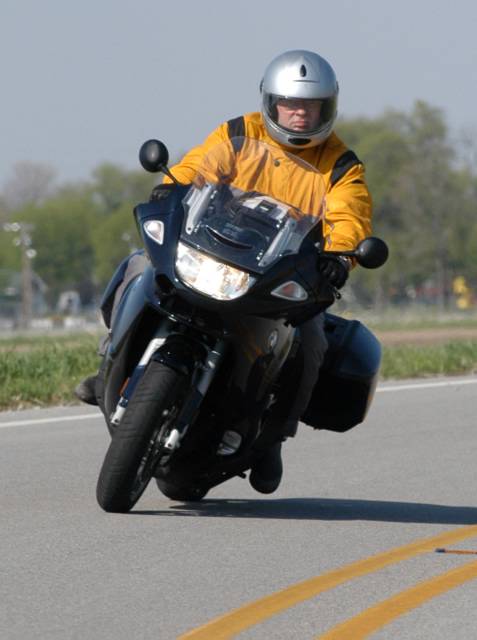
MFSDT
Here are the MFSDT (Most Frequently Said Dumb Things) heard by people who ride BMW motorcycles:
*BMW (Bavarian Motor Works, or Bayerische Motoren Werke in German) made motorcycles before they made cars. The company started out making engines for World War I airplanes and the blue-and-white company emblem is meant to represent the view from the cockpit of one of those planes with the blur of the propeller being the white and the blue being sky. After WWI, the Treaty of Versailles put a temporary ban on German aviation, so BMW turned to motorcycles as an interim product.
**Of course, they're hot, but not nearly as hot as you think, especially if you keep moving.
***Yes, we most likely did and we probably took the long way getting here. Very few BMWs get hauled around in trailers or pickup trucks. It's the bike of choice for the serious long-distance touring motorcyclist. If you need proof, go to Daytona Bike Week on the final Sunday and notice how many BMWs are being ridden home, compared with other brands. The Harley-Davidson people might as well call it "trailer week."
1. "I didn't know BMW made motorcycles."*
2. "Aren't those leathers hot?"**
3. "Did you ride all the way from _______ (insert state on your license plate here)?"***
*BMW (Bavarian Motor Works, or Bayerische Motoren Werke in German) made motorcycles before they made cars. The company started out making engines for World War I airplanes and the blue-and-white company emblem is meant to represent the view from the cockpit of one of those planes with the blur of the propeller being the white and the blue being sky. After WWI, the Treaty of Versailles put a temporary ban on German aviation, so BMW turned to motorcycles as an interim product.
**Of course, they're hot, but not nearly as hot as you think, especially if you keep moving.
***Yes, we most likely did and we probably took the long way getting here. Very few BMWs get hauled around in trailers or pickup trucks. It's the bike of choice for the serious long-distance touring motorcyclist. If you need proof, go to Daytona Bike Week on the final Sunday and notice how many BMWs are being ridden home, compared with other brands. The Harley-Davidson people might as well call it "trailer week."
Subscribe to:
Posts (Atom)